Trust · Gallery
Example decks made with Gamma AI
These are annotated shapes, the section order, teaching diagrams, and prompt starters we use when we talk about pitch, sales, product, classroom, investor update, and QBR decks. Open any card in Gamma to start from a prompt matched to that job. Recreate with your facts; do not present the placeholder narrative as if it were yours.
Examples are not trophies. They are decision aids: what to notice, what to cut, and which artifact the room needs. Pair them with the evaluation rubric when you compare tools, and with learn hubs when you want the craft behind the shape.
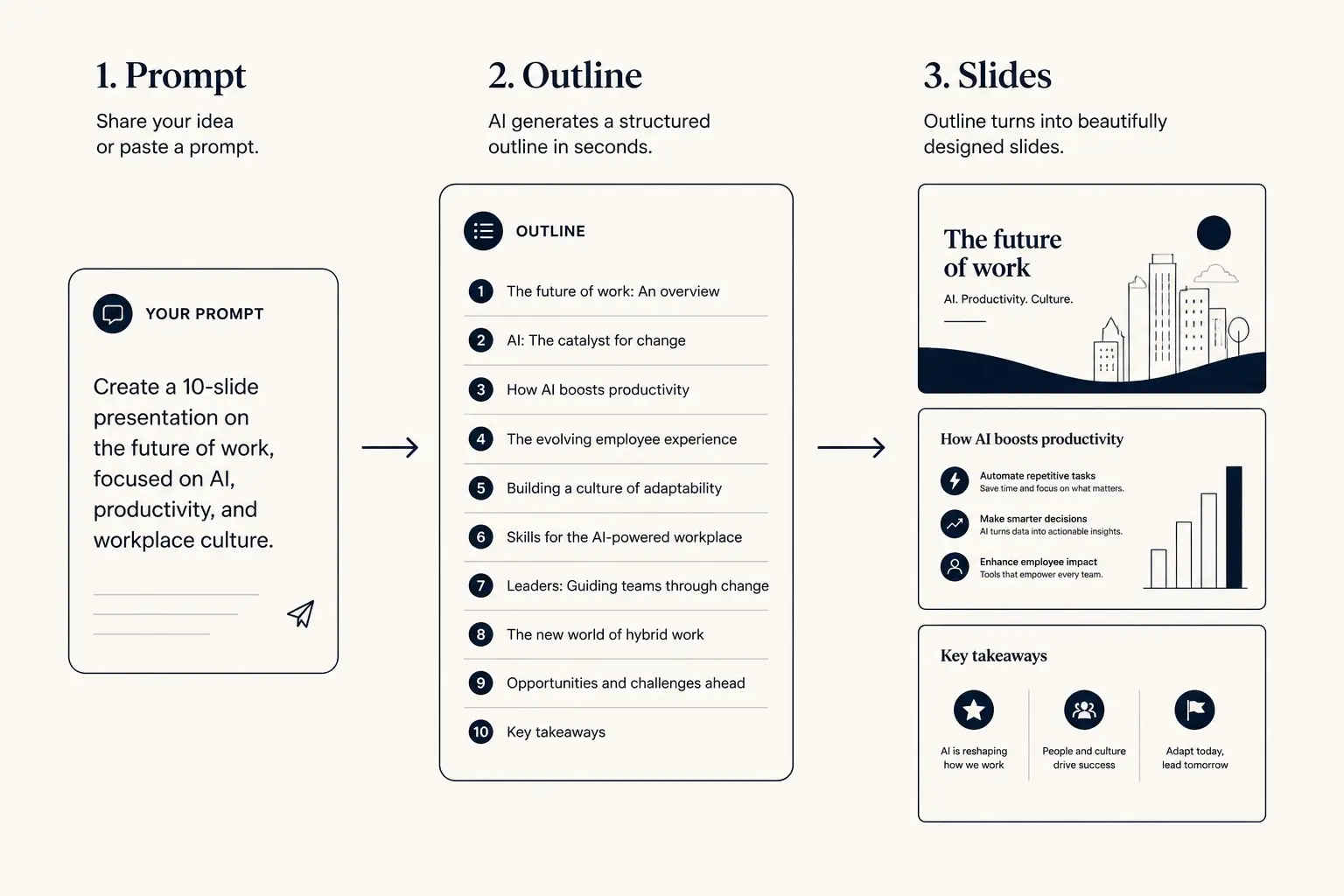
Prompt → outline → slides
1. Prompt
Audience, goal, length, proof you already have.
2. Outline
- • Opening claim
- • Proof beats
- • Ask / next step
3. Slides
How to use this gallery
Pick the job that matches your next meeting, not the prettiest thumbnail. Read the “what to notice” line before you generate. Copy the prompt into Gamma, replace bracketed facts with yours, then force one edit: reorder a section or swap a metric. That edit is how you learn whether the shape fits your room.
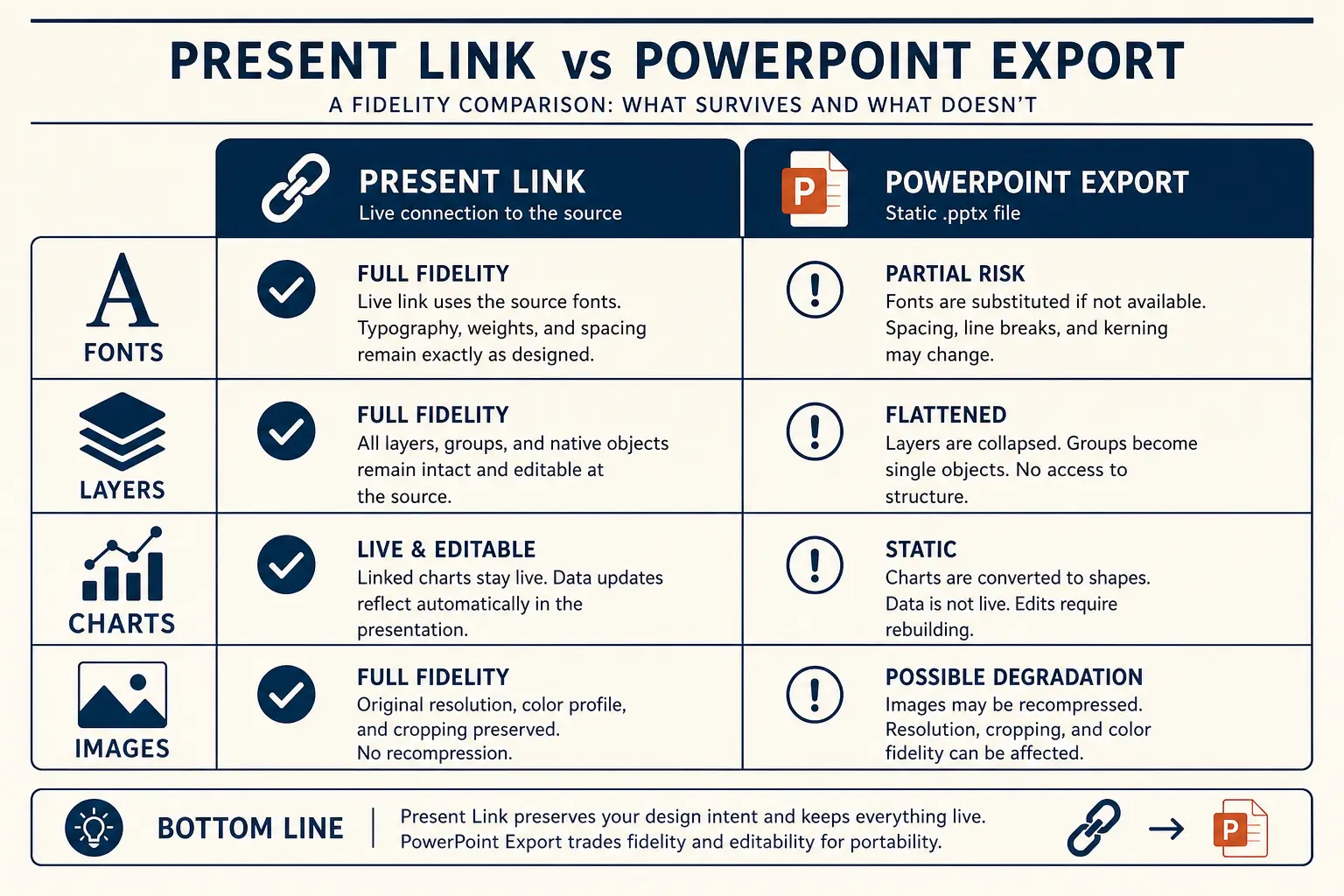
Decide the artifact early. Present links favor latest edits. PDFs favor durable pre-reads. PPTX favors buyers and boards that require PowerPoint as the system of record. Designing present-mode motion into a deck that must export tonight creates avoidable thrash, see the export map below.
Present link vs PPTX fidelity
Present link
- • Live latest edits
- • Best for your room
- • Analytics-friendly
Export PPTX / PDF
- • Offline / procurement
- • Brand review in PPT
- • Expect cleanup passes
Example gallery
Six jobs cover most of the rooms we serve. Cards still route to login so you can draft immediately. Teaching visuals are inline; PNGs add a second pass on what to notice. For deeper craft, open the matching learn hub after you generate.
Pitch
Seed pitch deck
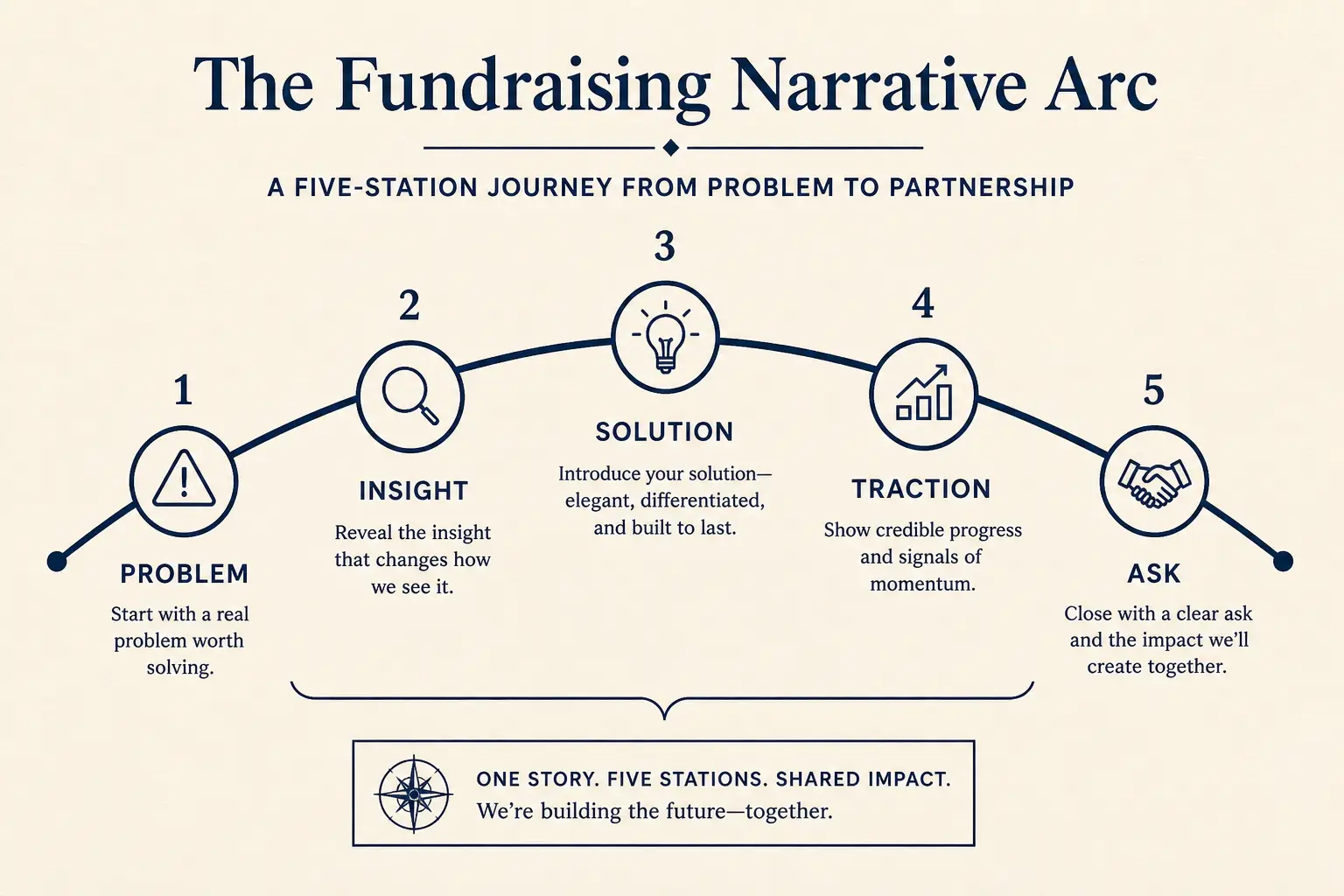
Problem → insight → wedge → market → product → traction → model → team → ask. Built for a first investor meeting, not a 40-slide appendix. Three dated metrics on traction; ask stands alone if forwarded.
What to notice: titles skim as a story; traction precedes the ask; TAM is a beachhead, not a Wikipedia dump.
Fundraising narrative arc
Tension early. Proof before the ask. Titles should skim as a story.
Starter prompt
10-slide seed pitch for a B2B workflow tool. Audience: seed investors in vertical SaaS. Include problem, wedge, three traction metrics with dates, and a $2.5M ask with use of funds. No fake logos.
Open in GammaSales
Buyer sales deck
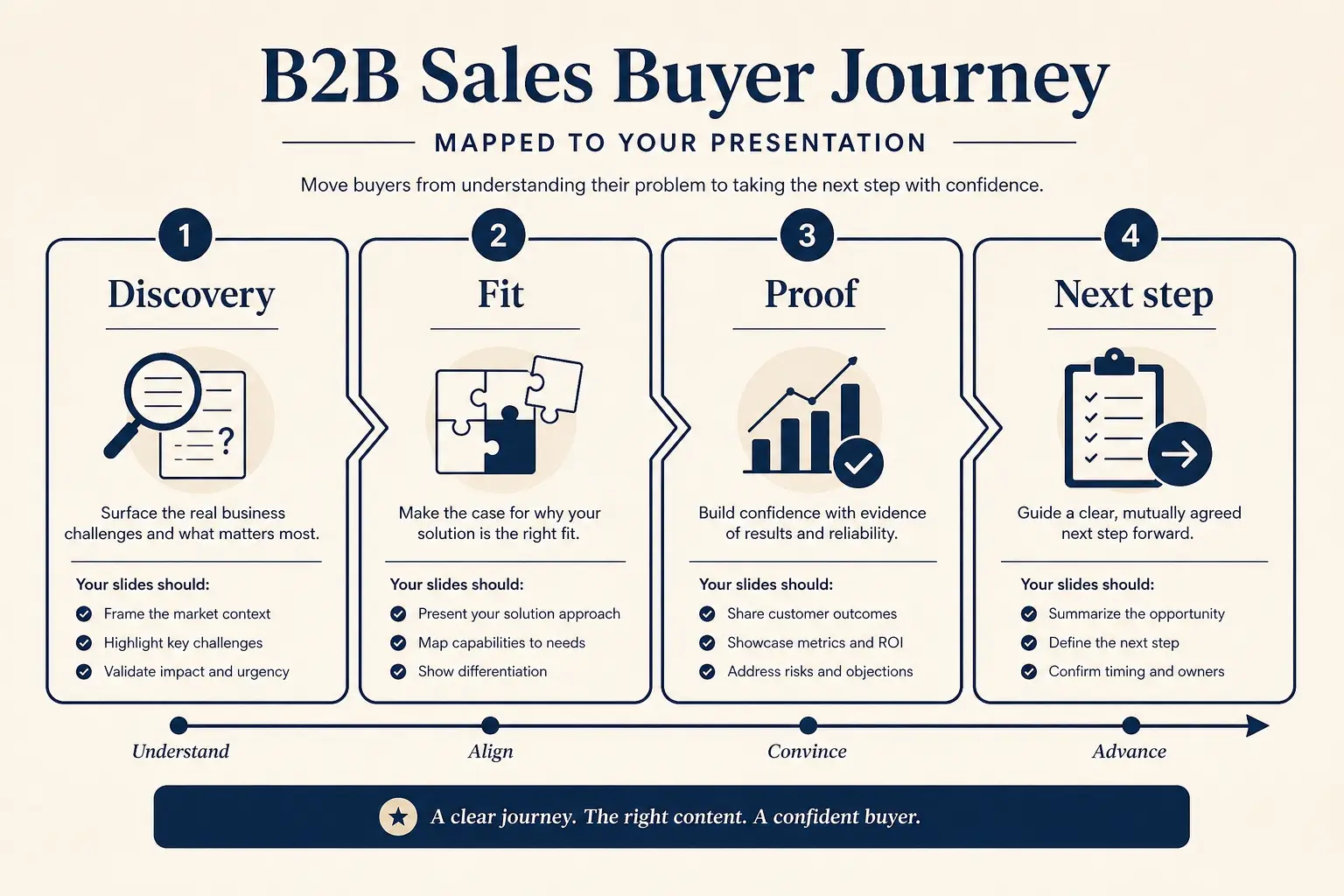
Discovery-informed narrative with pain in the buyer’s language, fit, inspectable ROI, risk handling, and a mutual plan date, not a feature dump from the website.
What to notice: slide one echoes discovery; next step names owner and date; ROI inputs are editable assumptions.
Buyer journey → slide map
Discovery
Pain + stakes
Fit
Why you win
Proof
ROI / risk
Next step
Clear ask
Starter prompt
12-slide sales deck for a mid-market ops leader. Open on their status-quo cost, show wedge fit, one ROI model with assumptions, security objection, mutual plan for a two-week pilot.
Open in GammaProduct
Product review
Decision-ready PR: goal, evidence, options with tradeoffs, recommendation, owners, and dates, ready for a 30-minute review, not a ticket tour.
What to notice: recommendation appears early; at least one rejected option is visible; metrics map to the ask.
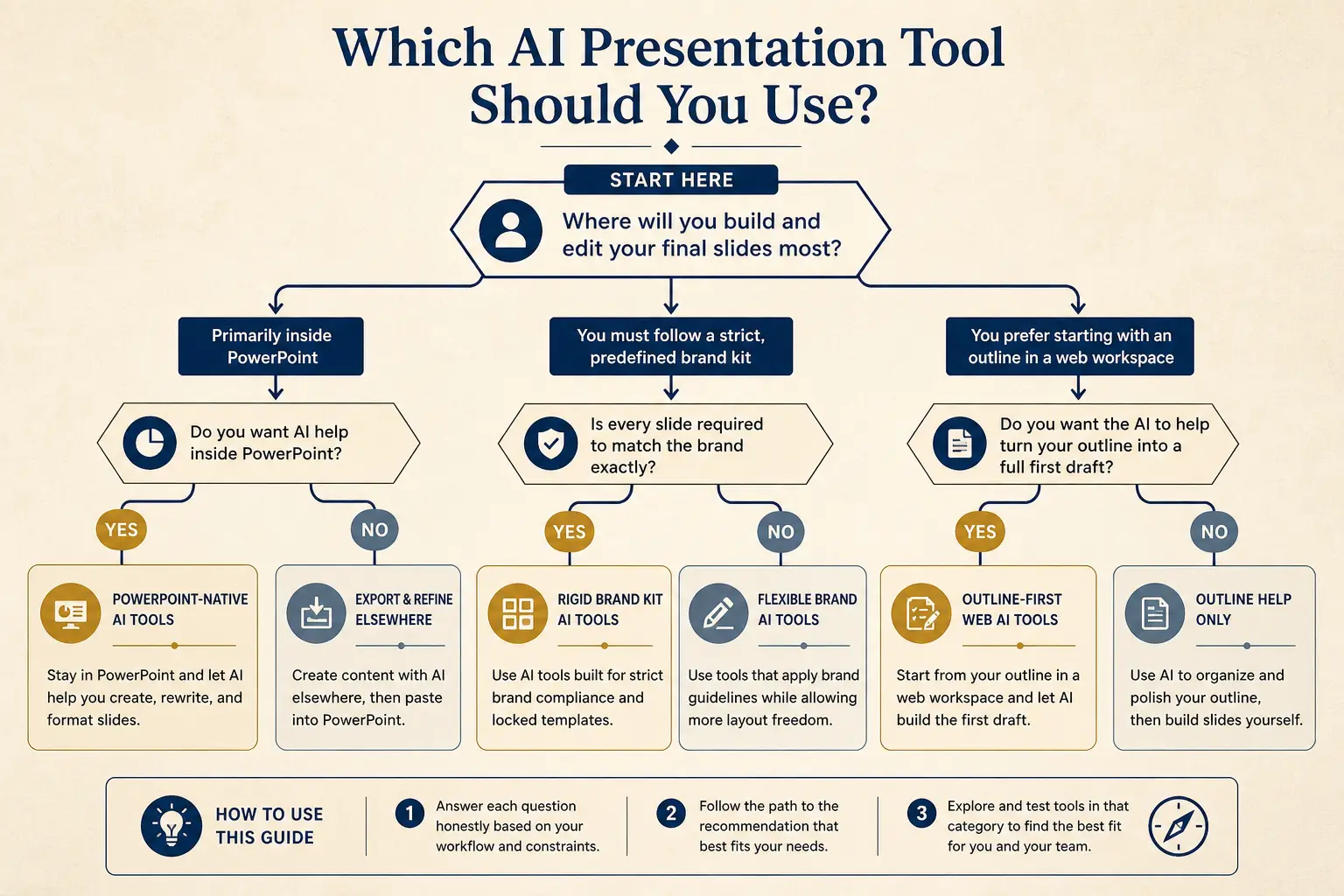
Which tool for which job
Need native PowerPoint editing every day?
Yes → Plus AI / Copilot · No → continue
Need rigid brand kits across a large team?
Yes → Beautiful.ai / enterprise kits · No → continue
Need outline-first AI drafting + present link?
Yes → Gamma
Starter prompt
Product review deck recommending we delay Feature X and fund reliability work. Include scorecard, options, recommendation, owners, and appendix index.
Open in GammaEducation
Classroom talk
Learning objectives, one idea per beat, examples, and a check-for-understanding close, useful for students and lecturers. Sparse enough to speak; not a handout pasted onto slides.
What to notice: objective in learner language; timing budget; CFU pause before the close.
Prompt → outline → slides
1. Prompt
Audience, goal, length, proof you already have.
2. Outline
- • Opening claim
- • Proof beats
- • Ask / next step
3. Slides
Starter prompt
12-minute class talk for grade 11 history on primary sources. State objective, three teaching beats with examples, check for understanding, takeaway assignment.
Open in GammaFundraising
Investor update
Highlights, lowlights, same metric spine each month, risks early, and asks investors can act on in one email hop. Cadence beats irregular essays.
What to notice: metric definitions stay stable; misses pair with cause and corrective action; asks are specific.
Slide density spectrum
Sparse
Live stage
1 claim, huge type
Balanced
Default
Claim + 3 proofs
Dense
Leave-behind
Detail for async read
Starter prompt
Monthly investor update. Lead with highlights and lowlights, show MRR, churn, cash, runway, one risk, and two specific asks for intros.
Open in GammaProduct
Quarterly business review
QBR shape: shared scorecard, wins/misses with causes, plan, resource asks, and an appendix index so deep dives do not derail the decision path.
What to notice: one scorecard spine; decision slide early; pre-read PDF denser than the live deck.
Time-to-usable-deck
Blank PPT path
Outline in docs → design fight → rebuild → 3–8 hours
Outline-first AI path
Prompt → edit outline → generate → polish → minutes to first usable draft
Starter prompt
QBR for a SaaS product org. Shared scorecard, churn miss with cohort truth, next-quarter plan, headcount ask, appendix index for deep dives.
Open in GammaWorked recreation: seed pitch in one sitting
Jordan has a seed meeting Thursday. Facts in hand: problem statement, wedge, three metrics, $2M ask. They open the seed pitch example, paste the starter prompt, and inject the real numbers. Outline pass kills a generic competitive matrix and moves traction before product. Slide pass keeps density balanced for a live room, leave-behind detail goes to an appendix they may never open. Present from a link; export PPTX only if the associate asks.
Time budget that usually works: 15 minutes on facts and prompt, 20 on outline edits, 25 on slide cleanup, 10 on ask rehearsal. If outline edits still feel wrong after 20 minutes, do not polish pixels, fix the story.
Time-to-usable-deck
Blank PPT path
Outline in docs → design fight → rebuild → 3–8 hours
Outline-first AI path
Prompt → edit outline → generate → polish → minutes to first usable draft
What these examples are not for
Do not ship an example unchanged. Do not use classroom shapes for board packs, or pitch density for a live demo. Do not treat diagrams as proof of product quality, proof is what happens when you force an edit with your facts. If you need rigid brand kits as the primary constraint, read compares before you standardize on Gamma.
Failure modes we see when people misuse the gallery: copying TAM theater, inventing ROI inputs, leading product reviews with status, and sending live-demo sparsity as a PDF leave-behind. Cut those before the meeting.
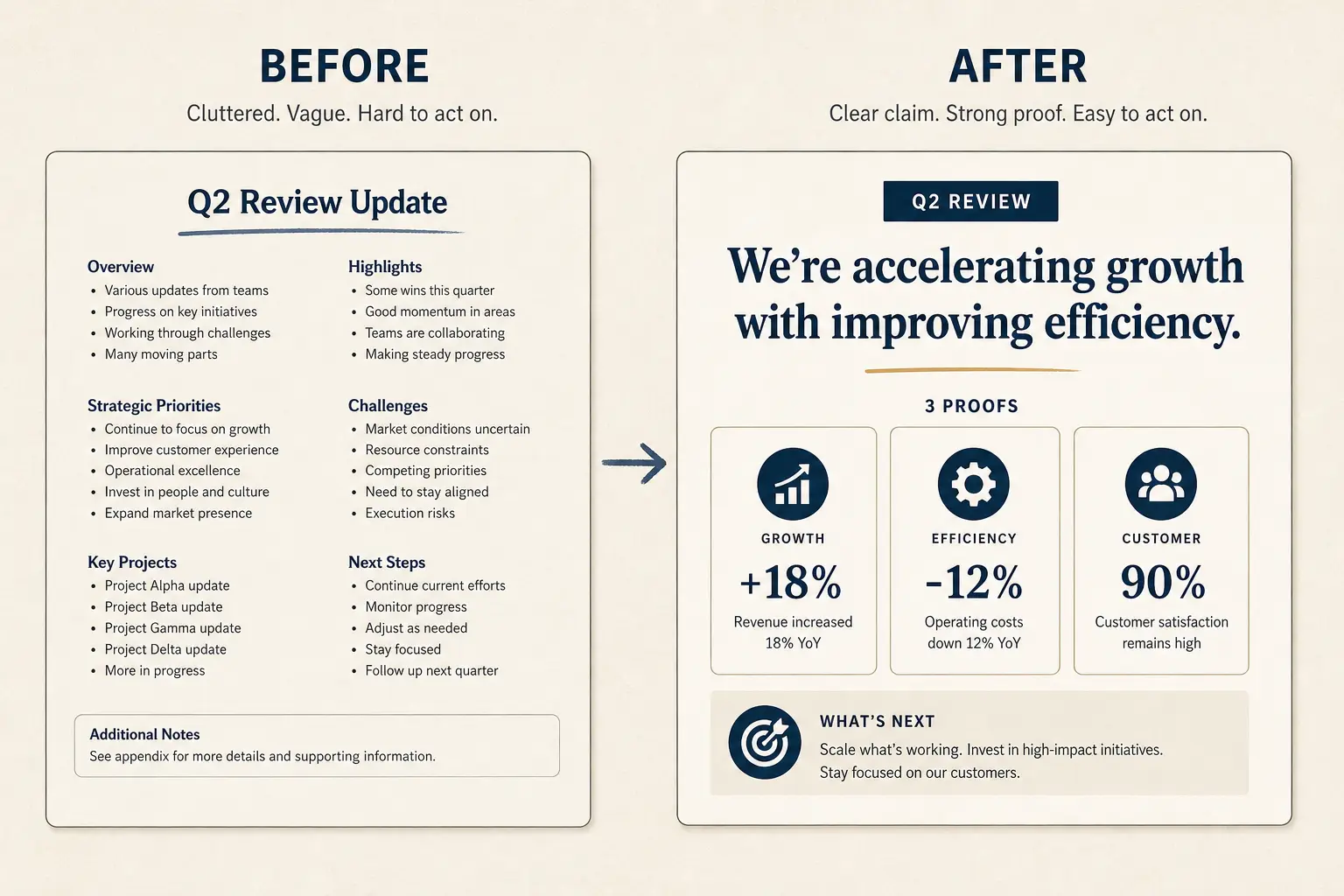
Weak slide → strong slide
Before
- • Overview
- • Features
- • Next steps???
After
- • Cost of status quo
- • Wedge in one claim
- • Proof + decision ask
Frameworks, worked rules, and cuts
Examples are annotated shapes for pitch, sales, product review, classroom, investor update, and QBR jobs. They teach section order, what to notice, and which artifact the room needs. They are not trophies and not permission to present placeholder narrative as if it were yours. Recreate with your facts and treat the starter prompt as a scaffold, not a script.
Original framework: Notice, Prompt, Force-Edit. Read the what-to-notice line. Copy the starter prompt into Gamma. Replace facts. Force one edit such as a reorder or metric swap. That edit teaches whether the shape fits your room better than staring at a thumbnail ever will, because thumbnails hide density and ask clarity.
Worked recreation: Jordan has a seed meeting Thursday with problem, wedge, three metrics, and a two million dollar ask. They open the seed pitch example, inject real numbers, kill a generic competitive matrix, move traction before product, keep density balanced for a live room, and park leave-behind detail in an appendix. Present from a link; export only on request.
Time budget that usually works for recreation is fifteen minutes on facts and prompt, twenty on outline edits, twenty-five on slide cleanup, and ten on ask rehearsal. If outline edits still feel wrong after twenty minutes, do not polish pixels. Your insight is not on the page yet, and layout work will only freeze the wrong story.
Artifact choice is part of the gallery. Present links favor latest edits. PDFs favor durable pre-reads. PPTX favors buyers and boards that require PowerPoint. Designing present-mode motion into a deck that must export tonight creates avoidable thrash. Score tools against the artifact you truly need, not a generic export checkbox.
Failure modes when misusing the gallery include shipping examples unchanged, using classroom shapes for board packs, pitch density for live demos, copying TAM theater, inventing ROI inputs, leading product reviews with status, and sending live-demo sparsity as a PDF leave-behind. Cut those mismatches before the meeting, not after feedback.
Not for you if you need rigid brand kits as the primary constraint before clarity, if you want screenshots to replace a forced edit test, or if you treat diagrams as proof of product quality. Proof is what happens when you force an edit with your facts and still recognize the narrative under pressure.
Concrete next step: pick the card that matches your next meeting, open in Gamma, paste the starter prompt with your metrics, force one reorder, and only then decide whether export is required. Pair with the matching learn hub for craft depth and the method page when comparing tools on the same gate.
Seed pitch cards reward title-only skims: problem, wedge, traction, ask should read as a story before body copy. If an associate forwards the deck without you, the ask slide must still name amount, use of funds, and near-term milestones. Kill competitive insult matrices; keep beachhead market framing that a partner can pressure-test.
Sales gallery cards fail when slide one still sounds like marketing copy. Echo discovery language, keep ROI inputs editable, and put a dated mutual plan on the last slide of the live path. Build a denser leave-behind only after objections are answered so the PDF is not a sparse demo screenshot pack.
Product review and QBR cards share one discipline: recommendation before status. Rejected options belong on the page so leadership sees the tradeoff, not a single path dressed as inevitability. Park incident timelines and ticket dumps behind an appendix index so a thirty-minute slot stays decision-shaped.
Classroom and investor-update cards look different on purpose. Teaching decks need learner-language objectives and a check-for-understanding pause; updates need a stable metric spine with deltas explained in prose. Do not borrow pitch density for either job just because the thumbnail looks finished.
Recreate an example with your facts
Bring your metrics and audience. Gamma drafts the structure; you edit before you present.