Sales
AI sales presentation that sounds like their discovery call
Gamma helps you build an AI sales presentation from buyer language, proof, and a concrete next step—not a recycled feature tour. Outline the problem in their words, attach ROI they can defend, and present or export when the champion needs a file to forward.
Who this AI sales presentation workflow is for
Use Gamma when you leave discovery with real notes and need a credible follow-up deck before the next meeting. It fits account executives, sales engineers building leave-behinds, solutions consultants scoping proposals, and founders selling mid-market deals without a huge enablement team. The shared pattern is account-specific language, a commercial next step, and limited time between calls.
- AEs who must turn discovery notes into a buyer-facing narrative overnight.
- SEs who need demo leave-behinds that stand alone when forwarded to IT.
- Leaders standardizing a spine while still allowing account personalization.
- Founders selling without a slide team and without sounding like a pitch deck.
Not for you if…
Skip this path if your org forbids any deck outside a locked PowerPoint master with legal-approved claims only—finish packaging there. Skip AI generation if you have not done discovery and hope the model will invent buyer pains; that produces generic tours buyers ignore. And if the meeting is a pure product demo with no narrative need, a live product environment may beat slides entirely.
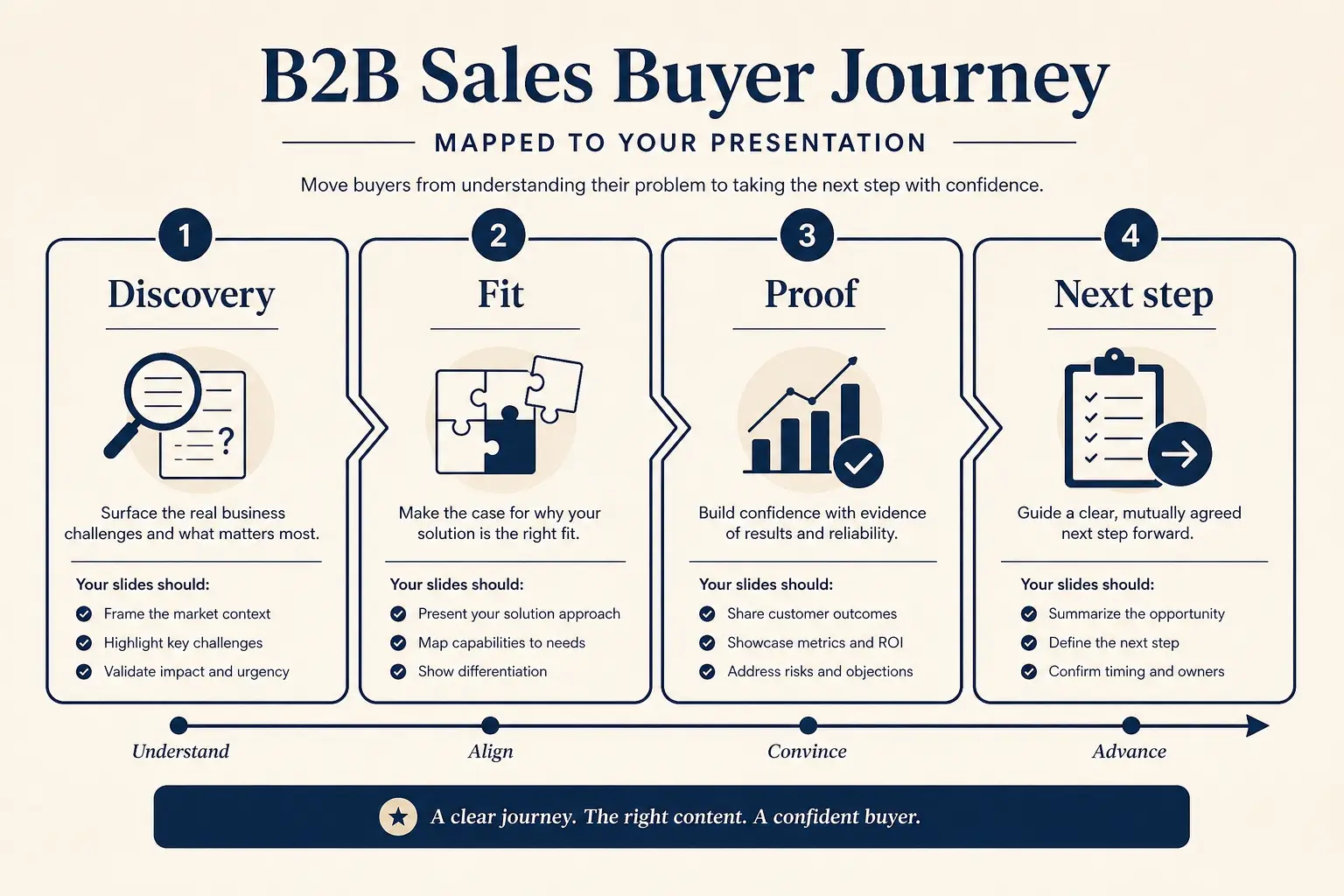
Buyer journey → slide map
Discovery
Pain + stakes
Fit
Why you win
Proof
ROI / risk
Next step
Clear ask
The PROVE framework for buyer decks
PROVE keeps AI sales presentations honest: Problem in their words, Reality of status-quo cost, Option wedge versus alternatives, Verification proof, and Exact next step. If any letter is missing, generation fills gaps with feature poetry. Write PROVE in five sentences after discovery, then expand into the outline. Titles should still make sense if body copy never loads.
- Problem, quote or closely paraphrase the buyer’s pain, not your category slogan.
- Reality, quantify cost in time, money, risk, or missed revenue using their context.
- Option, one wedge sentence versus the status quo and named alternatives.
- Verification, logos, metrics, or demo moments relevant to their industry.
- Exact next step, meeting type, owner, date, and what success looks like.
How Gamma builds a sales deck
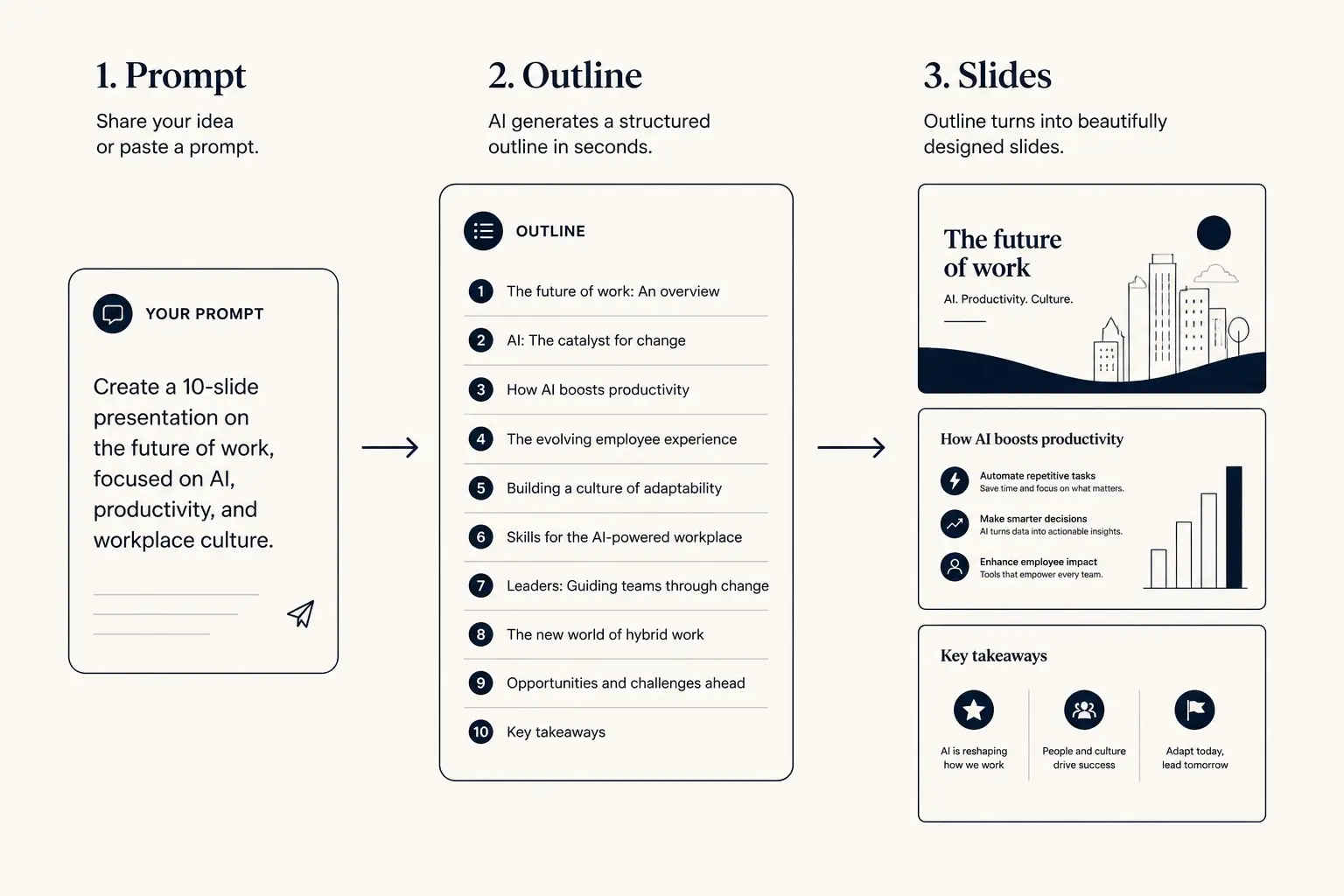
- Brief with PROVE and account facts from discovery.
- Outline gate—kill company history and unrelated modules.
- Slides with claim titles and proof placeholders you replace the same day.
- Present link for live rooms; PPTX or PDF when champions must forward a file.
Prompt → outline → slides
1. Prompt
Audience, goal, length, proof you already have.
2. Outline
- • Opening claim
- • Proof beats
- • Ask / next step
3. Slides
Outline preview
- Narrative, open with B2B SaaS sales deck for a
- Body, 3–5 slides that carry the argument
- Close, summary, risks, and the ask
Preview only, Gamma expands this into editable slides.
Slide budget for sales meetings
A thirty-minute discovery follow-up cannot carry twenty narrative slides. Leave-behinds can run denser. Set minutes and stakes, then increase count only if the deliverable must stand alone without you speaking.
Slide budget calculator
Get a realistic slide count from meeting length and stakes, then open a matching prompt in Gamma.
18
Total slides
13
Core narrative
5
Appendix
Create a 18-slide deck for executives who skim. Meeting length: 25 minutes. Stakes: high. Use an outline-first structure with 13 core narrative slides and 5 appendix slides. Every slide needs one claim and proof.
Open this budget in GammaWorked example: RevOps follow-up after discovery
Account: mid-market B2B SaaS, RevOps lead, Salesforce plus HubSpot stack. Pains named on the call: forecast accuracy swings week to week, managers rebuild pipeline reviews in spreadsheets, and stage hygiene is inconsistent across three regions. ACV for the opportunity is about $180k. Competitor mentioned: staying with spreadsheets plus a lighter forecasting add-on. Next step you want: technical validation with their Salesforce admin next Tuesday. Meeting length: twenty-five minutes with the champion and one skeptical director.
Live path: restated problem in their language, cost of forecast miss, wedge versus spreadsheet glue, product path in three beats tied to their stack, proof from a similar RevOps team, ROI sketch with their ACV and hours, security pointer, risks and mitigations, exact next step. Cut the founding story and the ten-feature grid. Put the director’s likely objection—implementation load—before the ask so it is not a surprise at the end.
| Slide | Buyer-facing claim | Proof input |
|---|---|---|
| Problem | Weekly forecast swings force managers back into spreadsheets | Their words from discovery plus hours spent on rebuilds |
| ROI | Recovering even 5 percent forecast accuracy protects a six-figure planning miss | $180k ACV context and time cost they confirmed |
| Ask | Book technical validation with Salesforce admin next Tuesday | Named attendees, agenda, and success criteria for that call |
Anatomy of a claim slide
Claim headline (one idea)
Supporting line that states the so-what for this audience.
Source / footnote
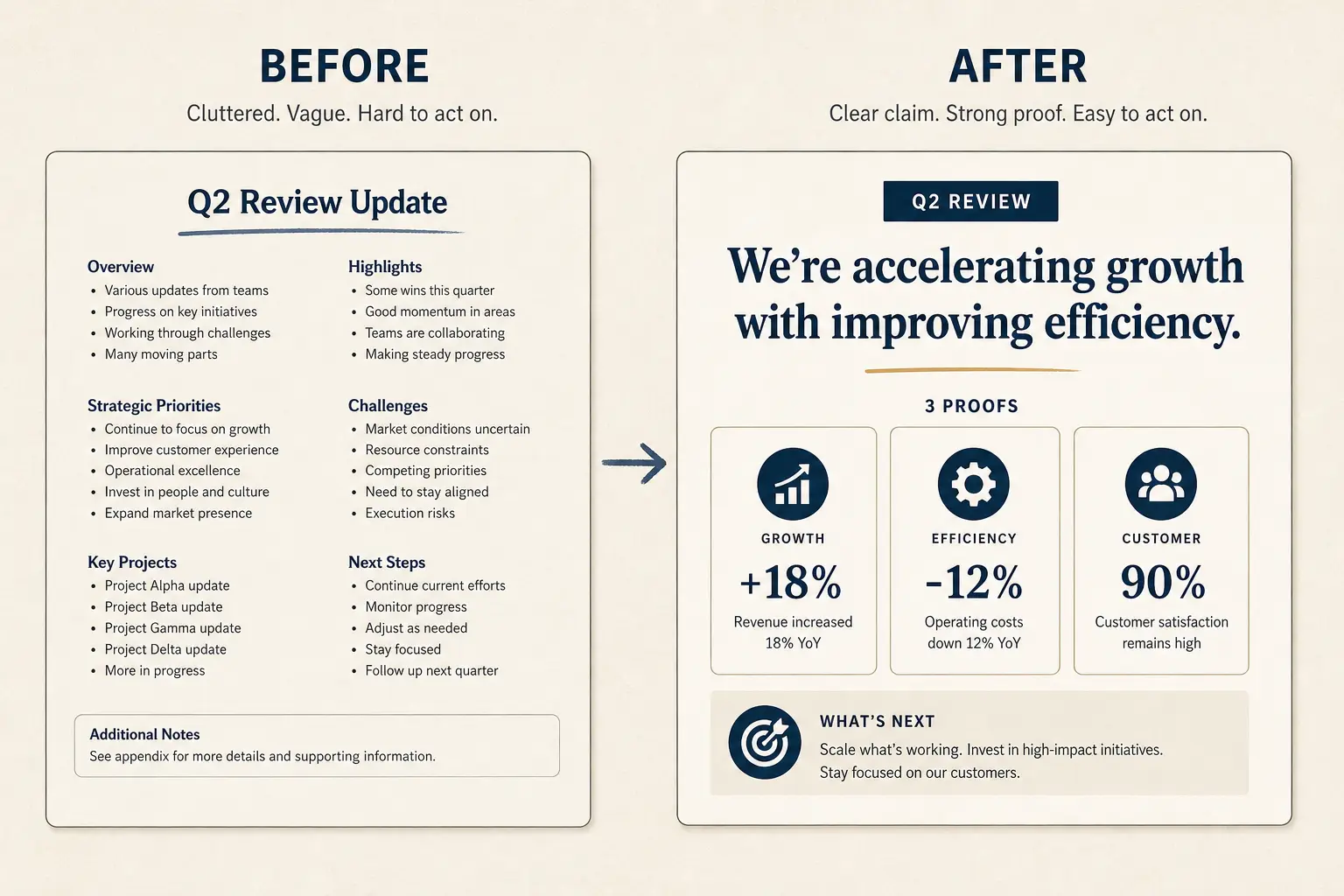
Rewrite feature soup before the meeting
Paste a weak slide. Force claim, proof, and ask. Then drop that structure into Gamma for the account deck.
Weak bullets → claim/proof/ask
Paste a bad slide. Get a rewrite pattern you can drop into Gamma, not vibes, a structure.
- Claim: Company overview (make the cost of inaction obvious)
- Proof: Platform features (add a number, name, or constraint)
- Proof: Integrations (add a number, name, or constraint)
- Proof: Customers (add a number, name, or constraint)
- Ask: Next steps (one decision, one owner, one date)
Mini comparison for sales tooling
Job-based splits beat feature bingo. See Compare and Method for scoring. Gamma wins on narrative personalization speed. Rigid brand-kit tools win when compliance packaging is the bottleneck. Native PowerPoint wins when the buyer’s process is file-first and locked.
| Constraint | Prefer Gamma | Prefer elsewhere |
|---|---|---|
| Fresh discovery notes | Outline-first account decks the same day | Static master decks that ignore account language |
| Brand kit lock | Draft spine, then package if required | Beautiful.ai or PowerPoint masters for rigid kits |
| Champion forwarding | Dense leave-behind path plus optional PPTX export | Native PPTX when procurement rejects links |
Present, export, and champion packs
Present from Gamma when you run the meeting. Export when champions must forward offline—details on export to PPTX. Keep security and pricing modules honest and current. For enablement reuse, start from the sales deck template after PROVE is clear. General AI deck craft lives on the AI presentation maker page; step-by-step ritual on create a presentation with AI.
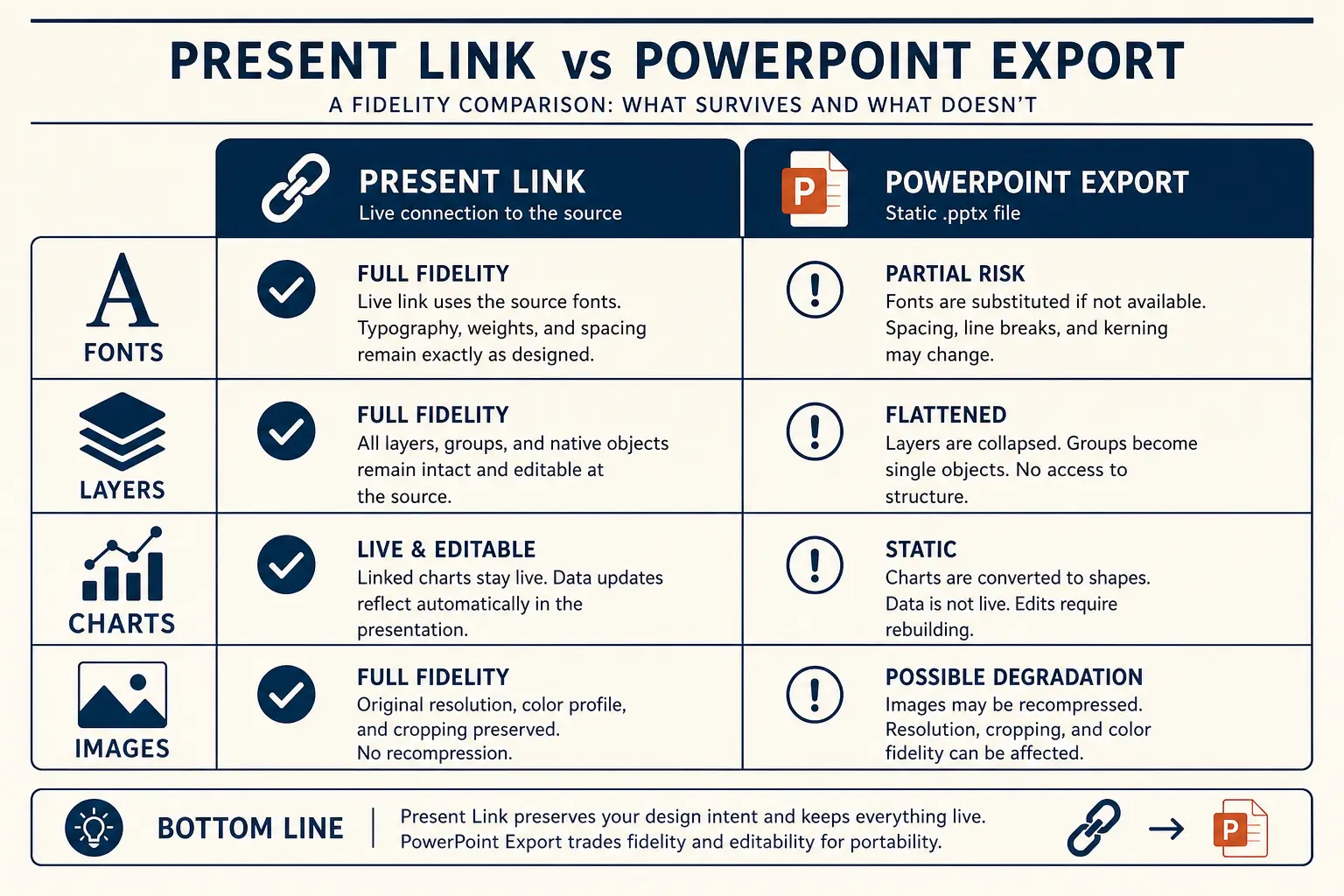
Present link vs PPTX fidelity
Present link
- • Live latest edits
- • Best for your room
- • Analytics-friendly
Export PPTX / PDF
- • Offline / procurement
- • Brand review in PPT
- • Expect cleanup passes
Slide density spectrum
Sparse
Live stage
1 claim, huge type
Balanced
Default
Claim + 3 proofs
Dense
Leave-behind
Detail for async read
Personalization checklist that scales
- Swap problem language to match discovery quotes before any design pass.
- Swap proof to the closest industry or stack match you can defend.
- Swap ROI inputs to their ACV, seats, or hours—not a generic calculator screenshot.
- Swap the ask to a dated meeting with named attendees and success criteria.
- Keep security and company boilerplate modular so you are not rewriting them every time.
- Delete any slide that does not change the buyer’s next decision.
Failure modes buyers punish
- Feature tours that never restate the buyer’s problem in their words.
- ROI without assumptions a champion can take to finance.
- Soft closes that say Next steps without owner, date, and purpose.
- Security handwaves that create later procurement risk.
- One mega-deck emailed to every account with names mail-merged only.
- Using a fundraising pitch spine for an enterprise commercial evaluation.
- Accepting AI-invented customer metrics that your reference cannot confirm.
- Overdense live decks that prevent conversation in a twenty-five minute room.
Go deeper in sales presentation guides under Learn, browse examples, or start from the sales deck template. The broader templates library covers adjacent job spines when discovery calls for a different artifact. Compare tools on the Compare index using the public Method rubric when you are still choosing software rather than closing a deal.
Enablement notes for reusing the spine
Enablement teams should treat the AI sales presentation spine as a modular system rather than a single frozen file. Keep problem, wedge, ROI, and ask modules account-specific. Keep security, company, and integration overview modules versioned centrally so individual AEs are not rewriting compliance language under deadline pressure. When a product change lands, update the central modules first, then regenerate account decks from fresh discovery notes rather than forever patching outdated feature tours.
Managers can review decks with a three-question ritual before forecast calls. Does the title spine restate this account’s discovery language. Does the ROI slide show assumptions a champion can defend. Does the closing slide name a dated next step with attendees and success criteria. If any answer is no, send the deck back before the customer ever sees it. This ritual catches most AI sales presentation failures without a design review.
For multi-threading, duplicate the outline into a technical track and an economic buyer track. The technical track expands security, implementation, and stack fit. The economic buyer track expands cost, ROI, and risk of delay. Keep the Exact next step aligned across both so the account does not receive conflicting asks. Present links help when numbers change during a busy evaluation week; export to PPTX when procurement refuses links.
Measure personalization quality by sampling five decks per month. Score each on buyer-language titles, proof relevance, ROI honesty, and ask specificity. Teams that only measure deck volume will reward feature tourism. Teams that measure these four axes will see AI speed turn into win-rate support rather than attachment spam.
If legal review is required before customer sends, keep a claims checklist beside the AI sales presentation workflow. Approved phrases for security and pricing belong in modular slides. Account-specific discovery language remains free-form. This split prevents AI drafting from inventing non-approved guarantees while still allowing personalization where it matters most for advancing the deal.
Frequently asked questions
Build the follow-up while discovery is fresh
Open Gamma with PROVE sentences and account facts. Edit the outline before you polish a feature tour nobody asked for.