Templates
AI sales deck template mapped to the buyer’s journey
Start from a Gamma sales deck template that restates discovery pains, proves the wedge, and closes on a dated next step—not a feature tour. Paste account truth, edit the outline, then present or export a pack champions can forward.
Who this sales deck template is for
Use this template when discovery notes exist and you need a buyer-facing follow-up, proposal, or leave-behind fast. It fits AEs, SEs, solutions consultants, and founders selling without a large enablement team. If you are raising capital, switch to the pitch deck template instead of forcing an investor arc onto a commercial evaluation.
- AEs turning discovery calls into next-meeting decks overnight.
- SEs building forwardable leave-behinds after demos.
- Leaders standardizing a spine while allowing account personalization.
- Founders who need buyer language more than fundraising theater.
Not for you if…
Skip if you have no discovery and want the model to invent pains. Skip if legal requires every slide inside a locked master from the first edit— draft here only if packaging finishes there. Skip for investor updates and board packets. And skip if you will not personalize problem, proof, ROI, and ask per account.
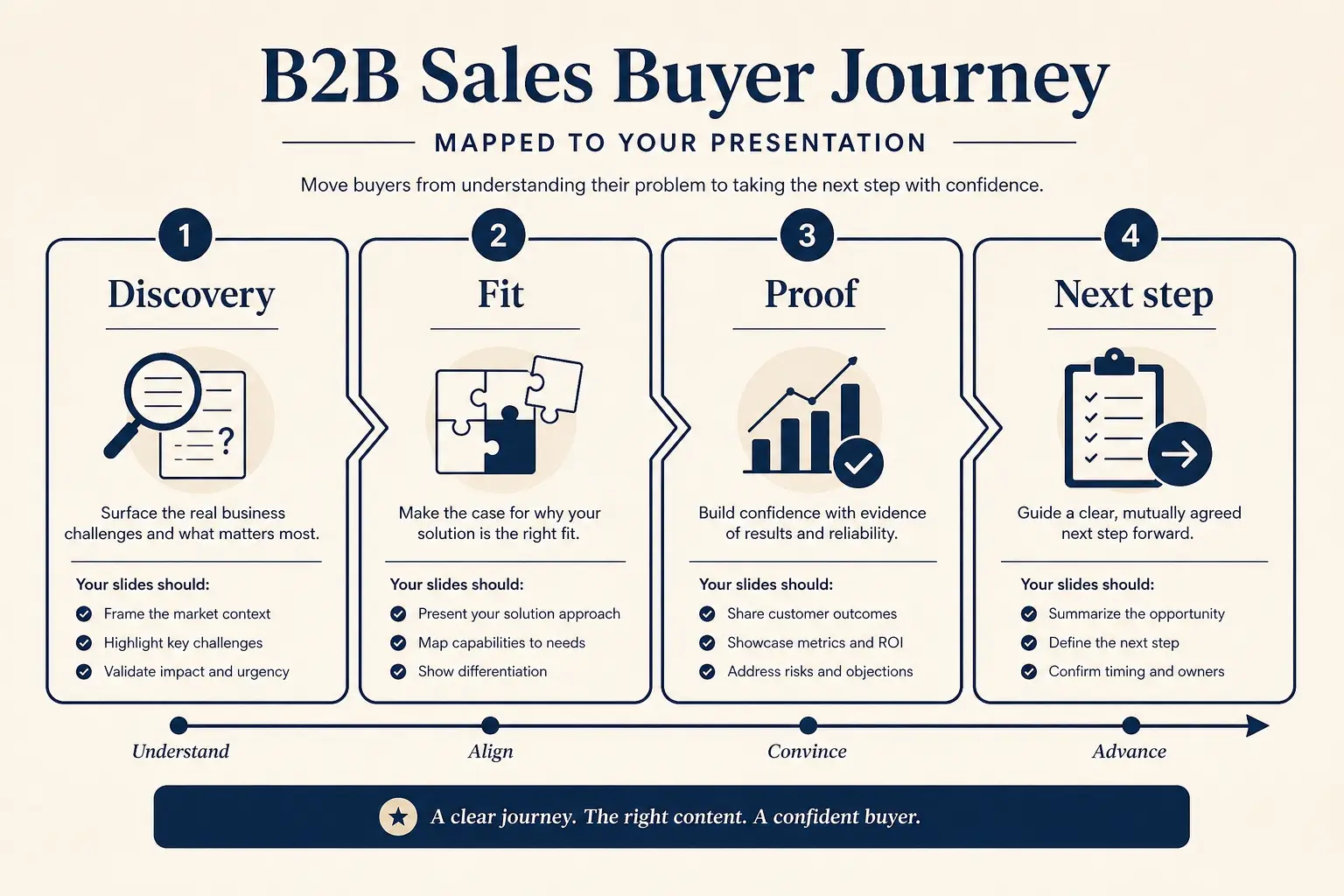
Buyer journey → slide map
Discovery
Pain + stakes
Fit
Why you win
Proof
ROI / risk
Next step
Clear ask
Template spine mapped to PROVE
The sales template encodes PROVE: Problem in their words, Reality of status-quo cost, Option wedge, Verification proof, Exact next step. Write PROVE from discovery before generating. If Problem sounds like your homepage slogan, rewrite until a champion recognizes their own call.
- Problem, paraphrase buyer language, not category slogans.
- Reality, quantify cost with their context.
- Option, wedge versus status quo and named alternatives.
- Verification, relevant proof, not random logo wallpaper.
- Exact next step, meeting type, owner, date, success criteria.
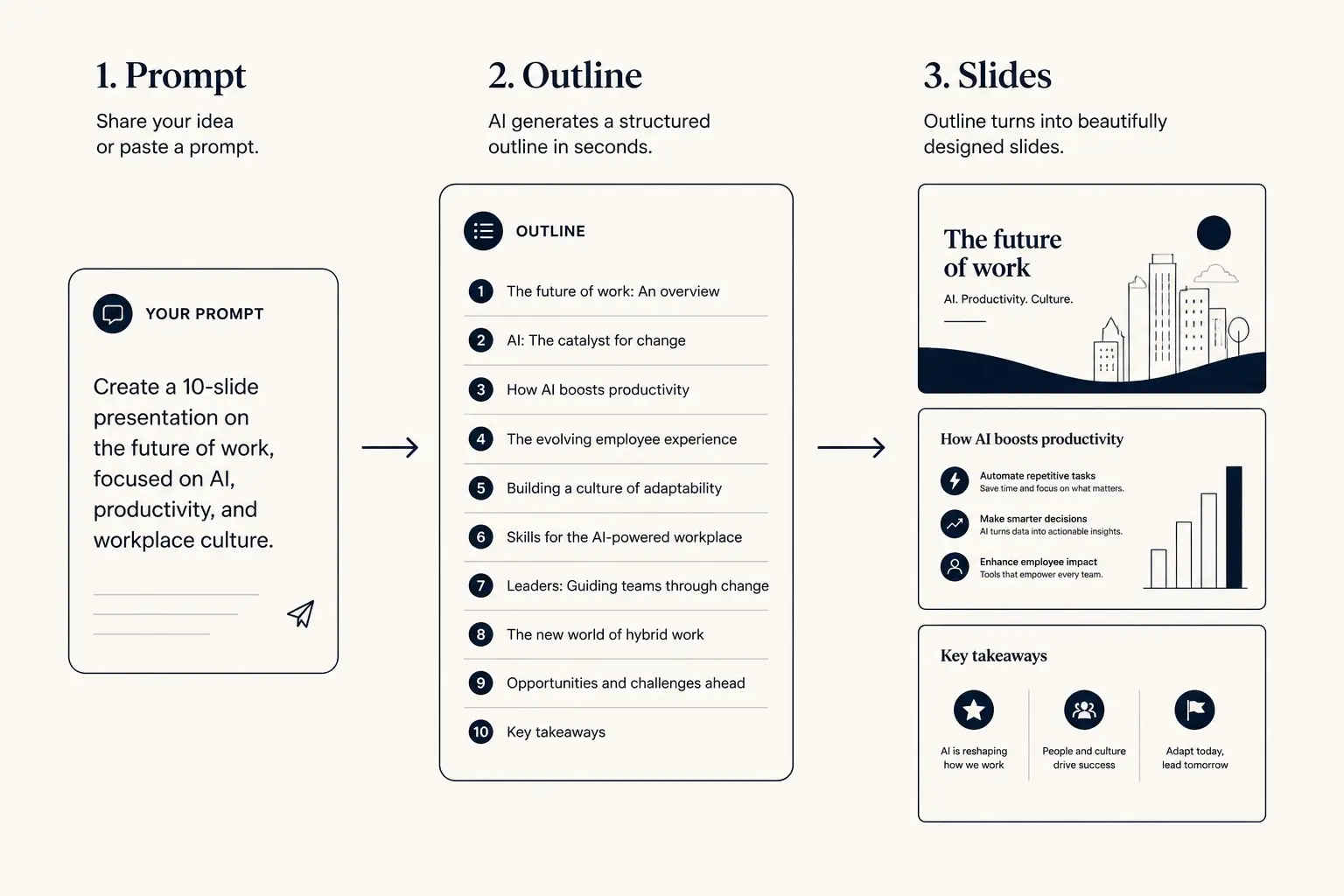
Prompt → outline → slides
1. Prompt
Audience, goal, length, proof you already have.
2. Outline
- • Opening claim
- • Proof beats
- • Ask / next step
3. Slides
Outline preview
- Narrative, open with Fill a sales deck template for
- Body, 3–5 slides that carry the argument
- Close, summary, risks, and the ask
Preview only, Gamma expands this into editable slides.
Budget for the sales meeting
Twenty-five minute follow-ups cannot carry twenty slides. Leave-behinds can run denser. Set minutes and stakes before you accept template length.
Slide budget calculator
Get a realistic slide count from meeting length and stakes, then open a matching prompt in Gamma.
18
Total slides
13
Core narrative
5
Appendix
Create a 18-slide deck for executives who skim. Meeting length: 25 minutes. Stakes: high. Use an outline-first structure with 13 core narrative slides and 5 appendix slides. Every slide needs one claim and proof.
Open this budget in GammaWorked example: filling after a RevOps discovery call
Buyer: RevOps lead, Salesforce plus HubSpot, forecast accuracy pain, spreadsheet rebuilds, $180k ACV opportunity. Fill Problem with their weekly forecast swing language. Fill Reality with hours spent rebuilding reviews. Fill Option with wedge versus spreadsheet glue plus lighter add-ons. Fill Verification with a similar RevOps proof. Fill Exact next step with technical validation next Tuesday including Salesforce admin. Cut founding story. Put implementation-load objection before the ask.
| Template block | Account-specific input | Reuse across accounts? |
|---|---|---|
| Problem | Their words on forecast swings and spreadsheet rebuilds | No, rewrite every time |
| Security | Standard answers plus any stack-specific notes | Mostly yes, modular boilerplate |
| Ask | Dated meeting with named attendees | No, always account-specific |
Anatomy of a claim slide
Claim headline (one idea)
Supporting line that states the so-what for this audience.
Source / footnote
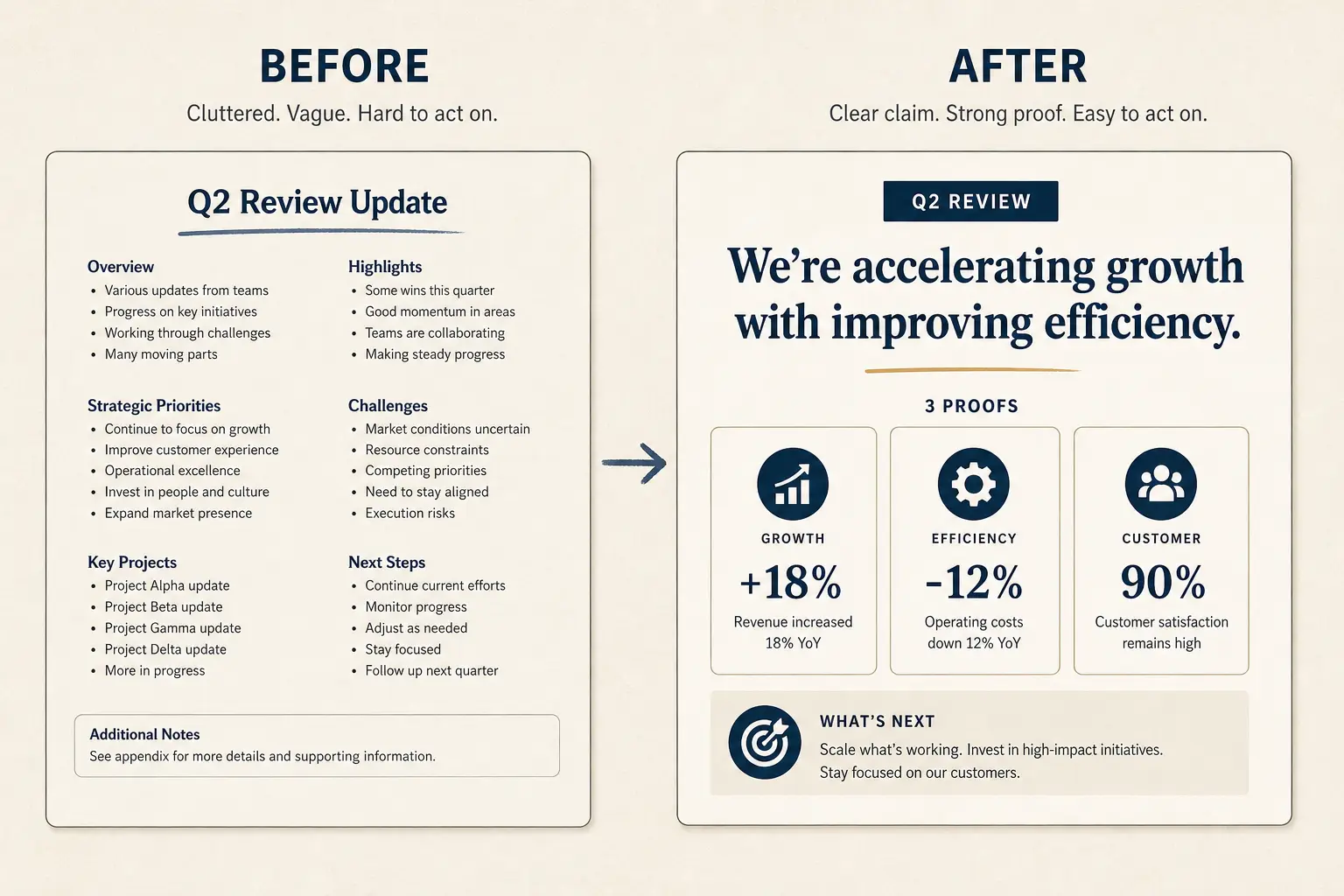
Rewrite a weak template fill
Weak bullets → claim/proof/ask
Paste a bad slide. Get a rewrite pattern you can drop into Gamma, not vibes, a structure.
- Claim: Company overview (make the cost of inaction obvious)
- Proof: Platform features (add a number, name, or constraint)
- Proof: Integrations (add a number, name, or constraint)
- Proof: Customers (add a number, name, or constraint)
- Ask: Next steps (one decision, one owner, one date)
Live path versus champion pack
Many opportunities need both: a sparer live deck and a denser forwardable pack from the same template spine. Duplicate the outline, densify the leave-behind, keep asks aligned so email forks do not disagree. Export guidance lives on export to PPTX. Broader sales craft on the AI sales presentation page. Templates hub if you need a different job spine.
Slide density spectrum
Sparse
Live stage
1 claim, huge type
Balanced
Default
Claim + 3 proofs
Dense
Leave-behind
Detail for async read
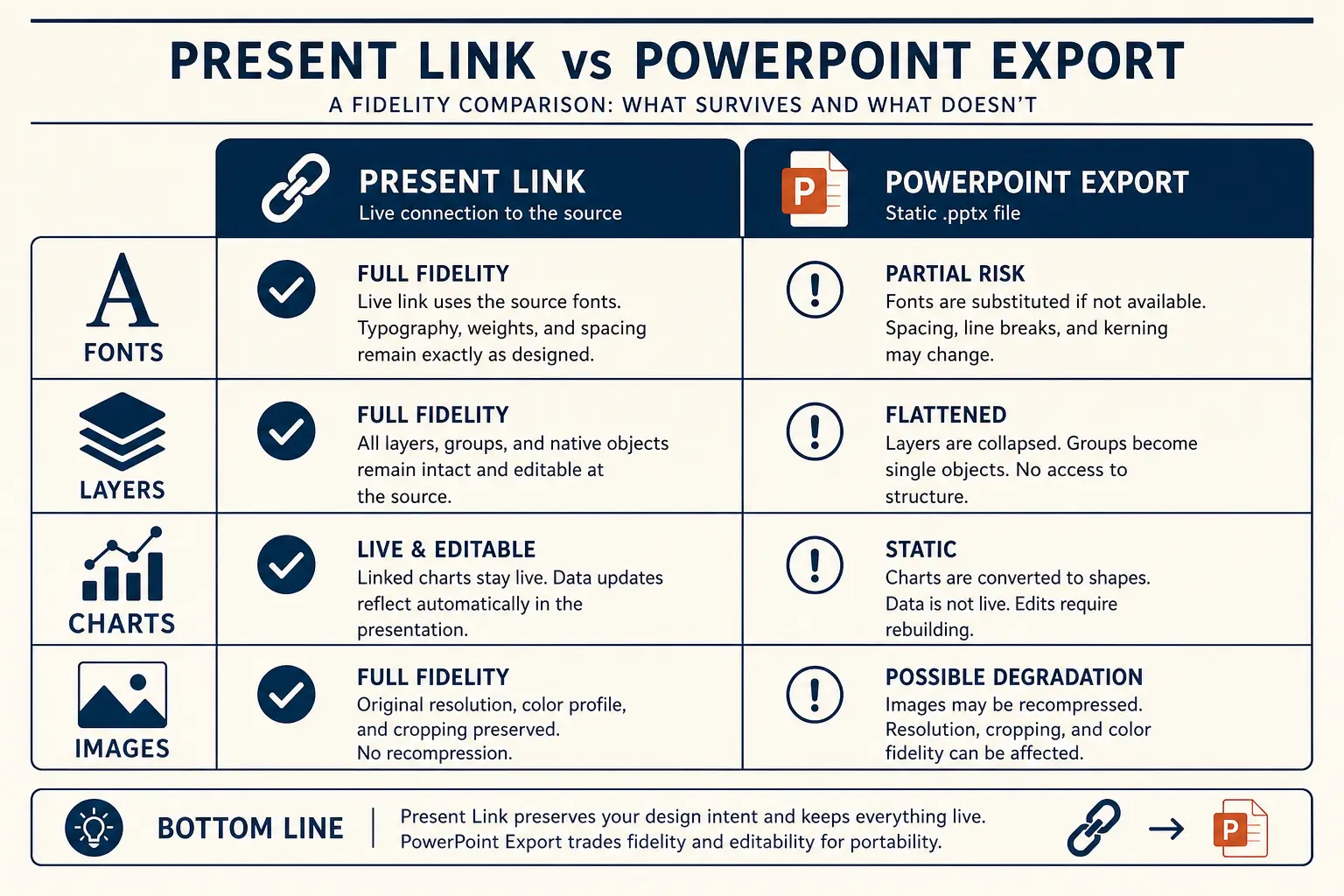
Present link vs PPTX fidelity
Present link
- • Live latest edits
- • Best for your room
- • Analytics-friendly
Export PPTX / PDF
- • Offline / procurement
- • Brand review in PPT
- • Expect cleanup passes
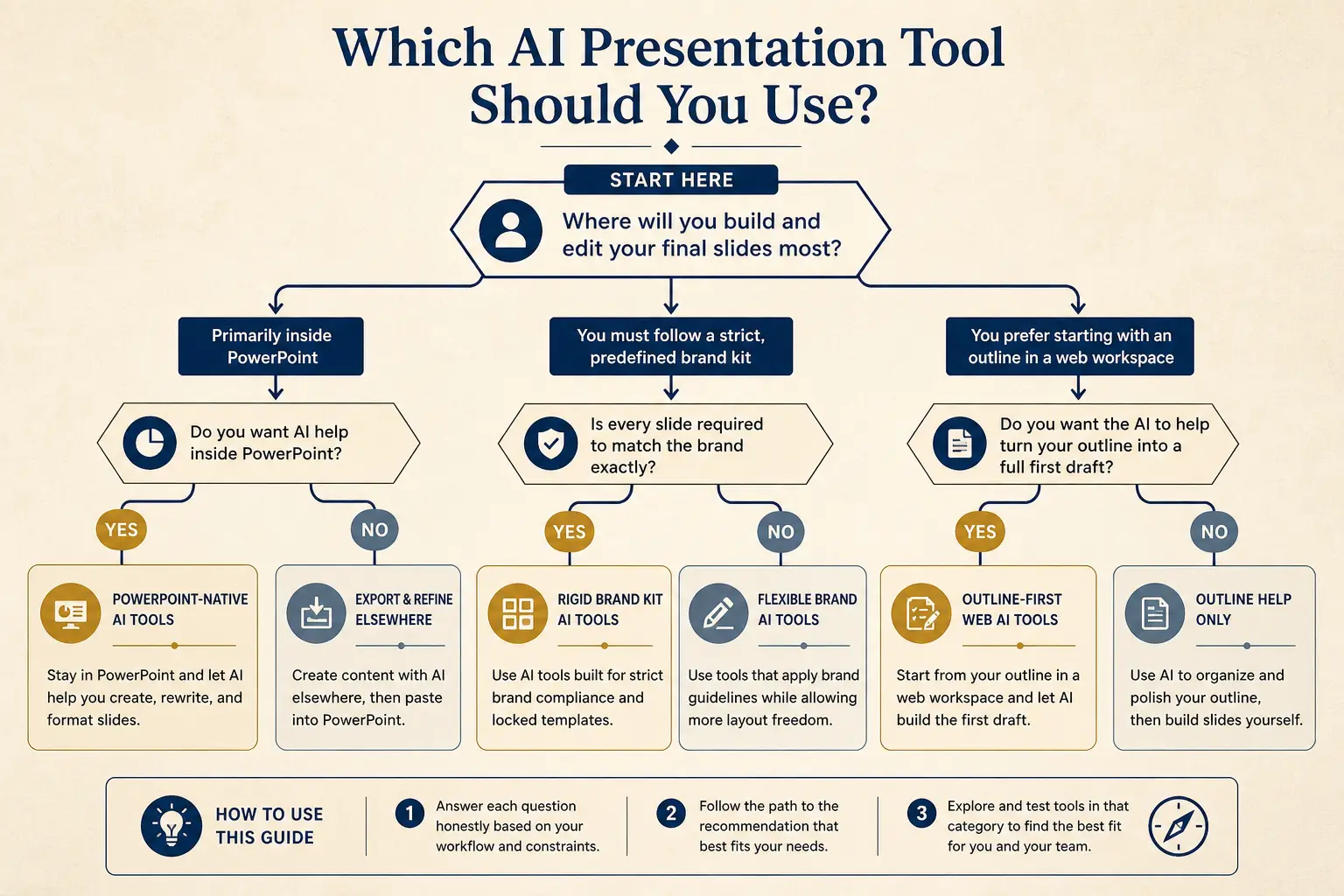
Which tool for which job
Need native PowerPoint editing every day?
Yes → Plus AI / Copilot · No → continue
Need rigid brand kits across a large team?
Yes → Beautiful.ai / enterprise kits · No → continue
Need outline-first AI drafting + present link?
Yes → Gamma
Personalization checklist
- Replace problem language with discovery quotes before design polish.
- Replace proof with the closest defensible industry or stack match.
- Replace ROI inputs with their ACV, seats, or hours.
- Replace the ask with a dated meeting and success criteria.
- Keep security and company modules modular.
- Delete any slide that does not change the buyer’s next decision.
Failure modes
- Feature tours that ignore discovery language.
- Soft closes without owner, date, and purpose.
- ROI without assumptions champions can take to finance.
- One mega-deck mailed to every account with names swapped only.
- Using the pitch template spine for enterprise evaluations.
- Accepting AI-invented customer metrics.
- Overdense live decks that kill conversation.
- Security handwaves that create procurement risk later.
Deepen craft in sales guides under Learn, study examples, and use the AI sales presentation page for PROVE detail. Return to the templates hub to switch jobs. Compare and Method when tooling—not the deal—is the question.
Revenue team habits for the sales template
Sales managers should review template fills the way they review call notes. Start with discovery fidelity. If the problem slide could belong to any account in the segment, it is not done. AI sales deck templates amplify whatever brief you provide. Thin briefs create thin personalization at scale, which buyers experience as spam with nicer layouts.
Build a shared objection library that plugs into the template rather than reinventing security and procurement answers in every deck. Centralize approved claims. Localize account-specific risk notes. This split keeps speed without creating compliance drift. When product marketing updates a claim, update the module once and communicate the change.
ROI slides deserve a special quality bar. Require visible assumptions, time windows, and sensitivity. If finance will reverse-engineer the number, inventing tidy savings is worse than a qualitative value narrative with honest gaps. Coaches should reject ROI slides that cannot be explained without the AE present.
Create two output modes from one spine: conversation mode and forward mode. Conversation mode is sparer for live meetings. Forward mode densifies for champions who must sell internally. Keep asks identical across modes. The template makes this duplication cheap; process makes it consistent.
Onboarding new AEs should include filling the template from a recorded discovery call, then comparing against a strong example. The exercise teaches PROVE faster than reading a playbook. Pair with the AI sales presentation money page so people understand why the spine exists, not only how to click generate.
Track cycle time from discovery to sent deck, and track meeting-held rate on the asked next step. Those two metrics tell you whether the template is helping advance deals. Volume of decks generated is a vanity metric. Advancement is the job. If cycle time drops but meeting-held rate stays flat, personalization quality is probably weak.
When deals involve heavy technical evaluation, add a technical validation agenda slide early rather than burying implementation at the end. Skeptical directors often decide based on load and risk before they care about feature breadth. The template should flex for that political map. Delete feature grids that do not change the next commercial step.
Finally, retire outdated screenshots and proof points on a schedule. Nothing damages a forwardable pack like a proof logo that churned or a UI that no longer exists. Template speed is wasted if trust dies on slide six. Assign proof hygiene ownership the same way you assign CRM hygiene.
Make discovery note quality a first-class input. AEs who capture buyer language, stack constraints, success metrics, and political map will fill the sales template well. AEs who capture only next steps will generate generic decks no matter how good the spine is. Manager coaching on notes improves AI output more than coaching on fonts.
For partner-led or channel sales, adapt the template so the partner’s value appears in the wedge and proof, not only as a logo. Buyers can tell when a deck was built for direct sales and lightly recolored. Exact next steps should also reflect who owns the relationship after the meeting.
Security questionnaires often arrive after the first deck. Keep a pointer slide in the template that sets expectations and links to trust materials rather than pretending a two-bullet slide answers procurement. Honesty here prevents stalled evaluations. AI should not invent certifications you do not have.
Quarterly, compare win/loss notes to template sections. If losses cite unclear ROI or fuzzy next steps, tighten those modules. If wins cite crisp discovery restatement, reinforce that habit in onboarding. The sales deck template should evolve with market feedback, not remain static enablement art.
Multi-threading without deck sprawl
Complex deals often need economic buyer, champion, and technical evaluator versions of the same PROVE spine. Do not maintain three unrelated files. Keep one master outline with account facts, then generate conversation-mode and forward-mode outputs that share identical asks and ROI assumptions. When a champion forwards the pack, every stakeholder should see the same next step and the same numbers, only density and emphasis should change.
After a stage advances, archive the prior deck version with a date stamp instead of silently overwriting it. Win/loss reviews need the artifact the buyer actually saw. AI makes regeneration cheap; institutional memory still requires deliberate versioning. Pair that discipline with CRM fields for discovery language so the next AE who inherits the account can refill the template without starting from a blank brief.
Frequently asked questions
Fill the sales spine while discovery is fresh
Open Gamma’s sales template with PROVE sentences and account facts. Personalize problem, proof, ROI, and ask—then present.