Learn · Sales
Discovery call to presentation the same day
Discovery to deck is a same-day operating ritual: tag the call, lock titles, generate outline-first, cut twenty percent, and send a buyer-specific follow-up while the conversation is still warm. Speed without tags produces generic slides. Tags without speed loses the deal’s momentum.
Hub: sales presentations. Method: Method. Examples: examples.
Spine: sales deck structure. Variables: personalize decks at scale.
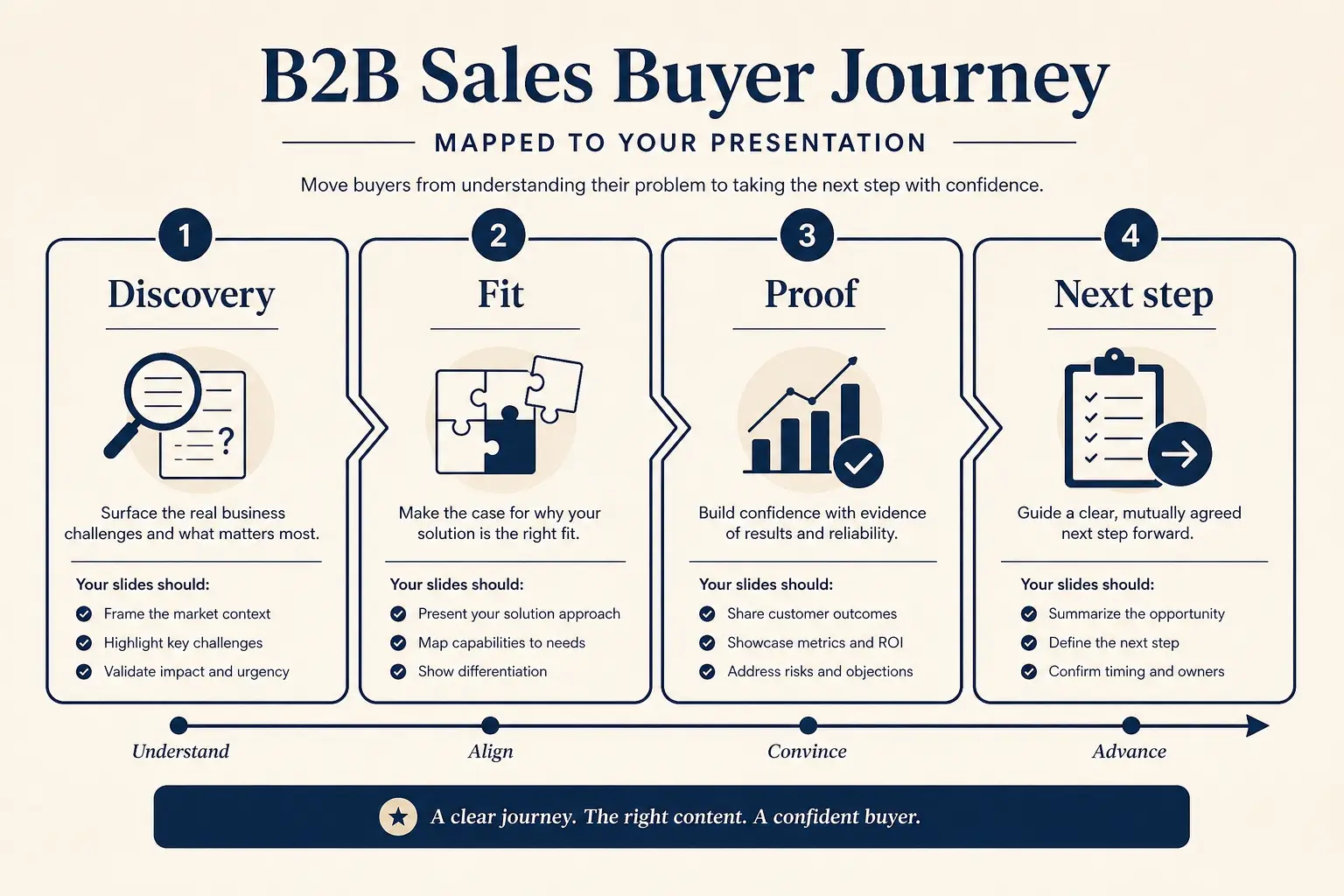
The four-bucket tag system
During or immediately after the call, sort notes into pains with verbatim phrases, success criteria, stakeholders and objections, and commercial constraints including timeline and budget signals. Circle the agreed next step or draft one. These buckets map directly to the eight-block sales spine. Untagged transcripts invite feature dumps.
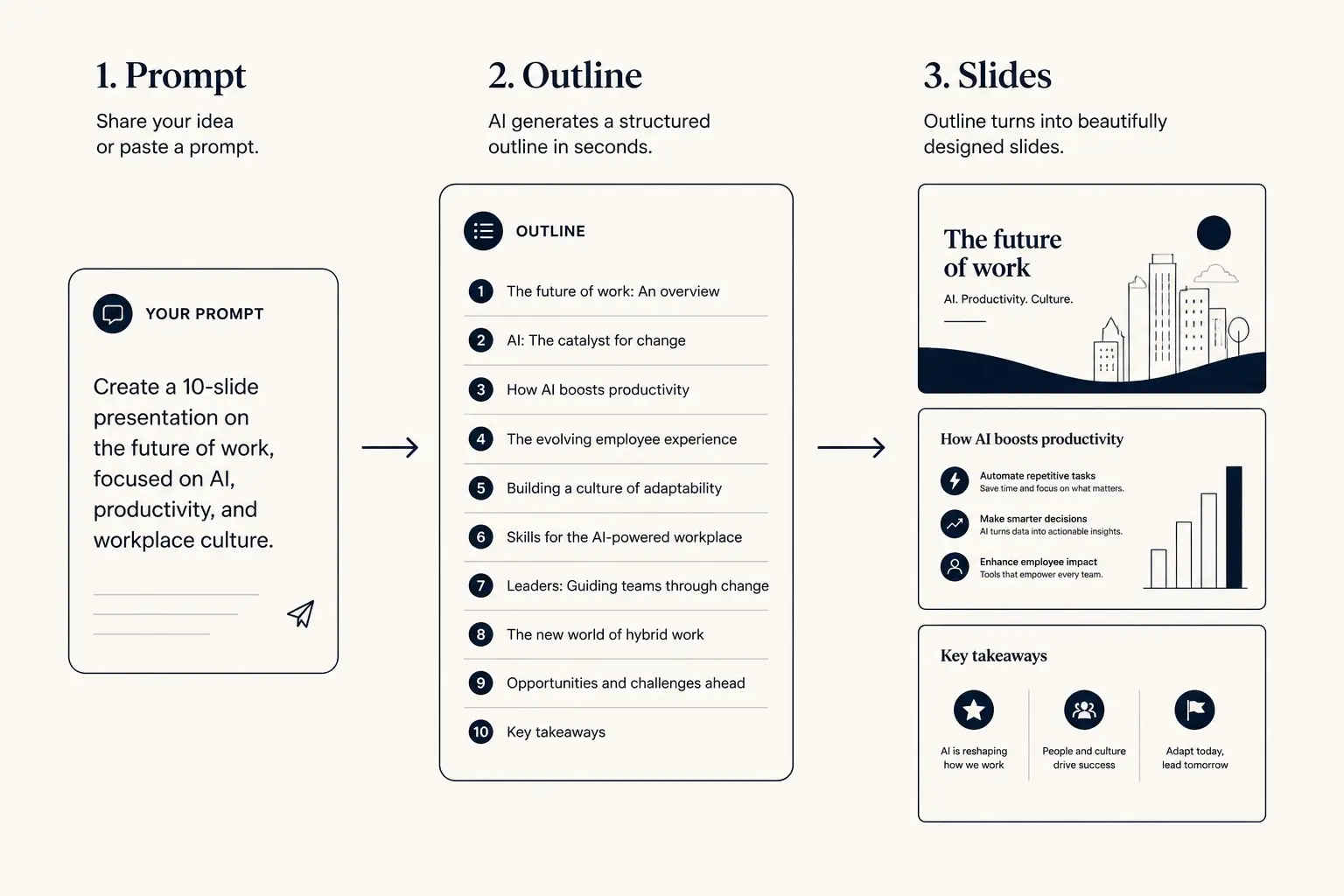
Prompt → outline → slides
1. Prompt
Audience, goal, length, proof you already have.
2. Outline
- • Opening claim
- • Proof beats
- • Ask / next step
3. Slides
Ninety-minute same-day workflow
Minutes zero to fifteen: tag buckets and write eight claim titles only. Minutes fifteen to twenty-five: title-only read with SE or manager. Minutes twenty-five to fifty: generate in Gamma, swap proof modules from the approved library, fill ROI inputs if known. Minutes fifty to seventy: cut twenty percent, check stakeholder beliefs, write mutual plan. Minutes seventy to ninety: produce leave-behind twin if needed, send present link, log CRM next step to match the last slide.
Time-to-usable-deck
Blank PPT path
Outline in docs → design fight → rebuild → 3–8 hours
Outline-first AI path
Prompt → edit outline → generate → polish → minutes to first usable draft
Worked example: forty-two minute discovery
Tags captured: pain phrase weekend overtime on returns; success thirty percent faster before Q4; objection Shopify NetSuite sync risk; commercial payback under nine months; next step Tuesday technical workshop with two engineers and RevOps. Titles written in twelve minutes. Deck generated and cut to nine live slides. Sent at 4:40pm with mutual plan listing Tuesday attendees. No founding story. No generic retail trends. Champion replied same evening confirming workshop agenda.
Interactive: from notes to outline
Paste tagged notes. Reject any outline section that cannot point to a tag.
Outline preview
- Narrative, open with From discovery notes: VP Ops overtime
- Body, 3–5 slides that carry the argument
- Close, summary, risks, and the ask
Preview only, Gamma expands this into editable slides.
Stakeholder belief check before send
List who will read or attend next. For each, name the belief the deck must create. If a belief lacks a slide, add proof or cut the attendee expectation. Fifteen-minute stakeholders get a three-slide express path: cost, wedge, ask.
Anatomy of a claim slide
Claim headline (one idea)
Supporting line that states the so-what for this audience.
Source / footnote
Failure modes
- Transcript dump, AI summarizes everything. Fix: four buckets first.
- Next-day generic, Waiting kills phrases. Fix: same-day SLA.
- Feature invention, Unmapped capabilities. Fix: reject outline sections.
- No mutual plan, Soft close. Fix: dated owners on last slide.
- CRM mismatch, Deck says Tuesday, CRM says follow up later. Fix: match fields.
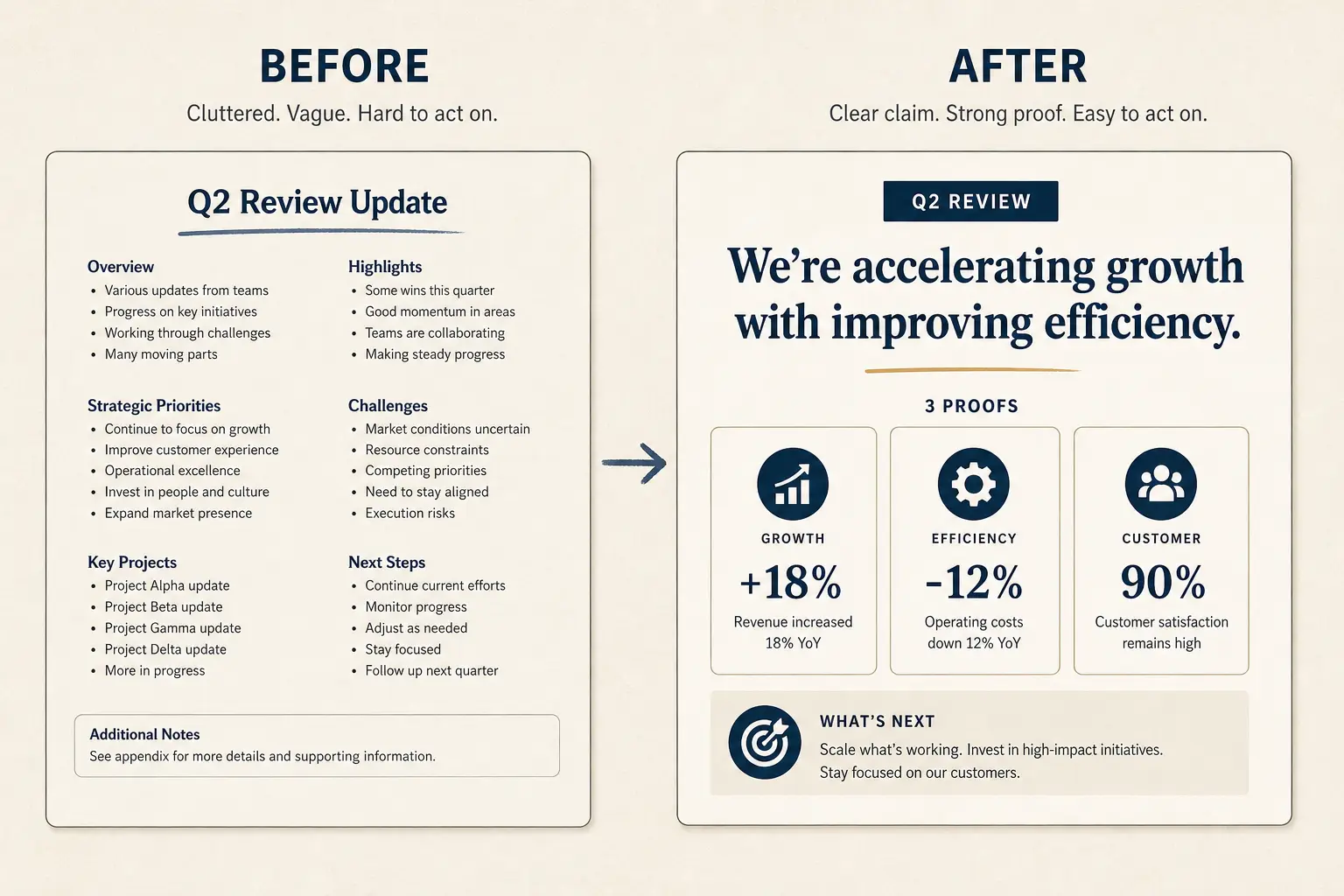
Weak slide → strong slide
Before
- • Overview
- • Features
- • Next steps???
After
- • Cost of status quo
- • Wedge in one claim
- • Proof + decision ask
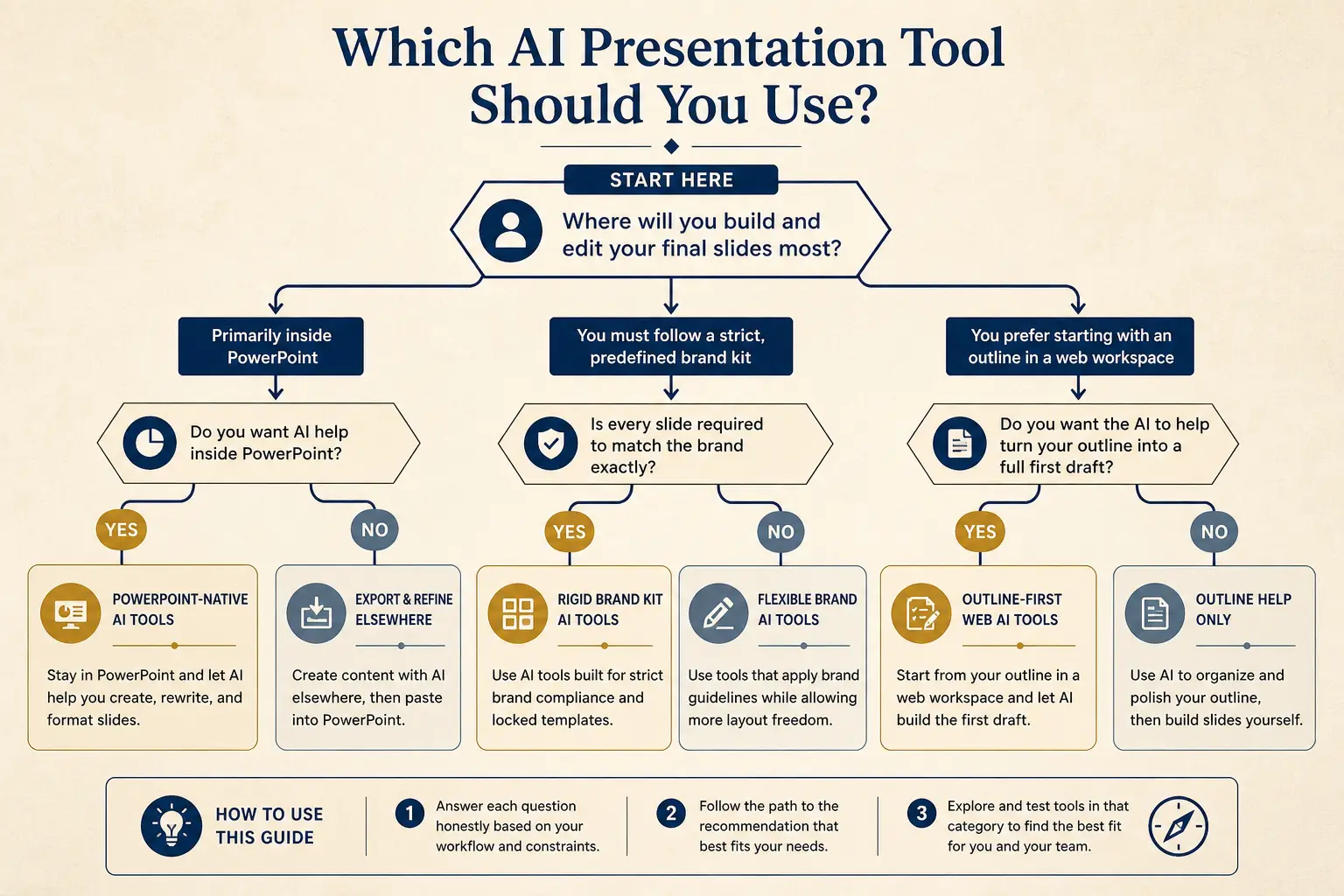
Which tool for which job
Need native PowerPoint editing every day?
Yes → Plus AI / Copilot · No → continue
Need rigid brand kits across a large team?
Yes → Beautiful.ai / enterprise kits · No → continue
Need outline-first AI drafting + present link?
Yes → Gamma
Not for you if…
If discovery was a drive-by demo with no notes culture, fix the call process before the deck process. If legal requires all customer materials through a two-day review, pre-approve master modules so same-day is variable swaps only.
Gamma next step
After your next discovery call, spend fifteen minutes tagging, then paste into AI sales presentation or AI presentation maker with the eight-block order locked. Send the live twin before you leave for the day.
Slide density spectrum
Sparse
Live stage
1 claim, huge type
Balanced
Default
Claim + 3 proofs
Dense
Leave-behind
Detail for async read
Present link vs PPTX fidelity
Present link
- • Live latest edits
- • Best for your room
- • Analytics-friendly
Export PPTX / PDF
- • Offline / procurement
- • Brand review in PPT
- • Expect cleanup passes
Operating system: controls that keep AI drafts honest
Same-day discovery-to-deck fails when notes are not tagged before generation. Write the decision the meeting must produce before you open the generator. Assign an owner for every assumption on the slide. Schedule a title-only review with someone who was not in the source meeting. When those three controls exist, AI drafts accelerate the spine instead of decorating a vague brochure. When they do not, you get polished ambiguity that stalls in the room. Keep a one-page failure log of decks that missed their job—wrong density, missing cost or decision framing, soft close, unlabeled options, invented metrics—and coach the pattern, not the personality of the author.
Checklist before send for Discovery call to presentation the same day: every headline uses audience language; every proof artifact has a commitment label; every number has a source; the last slide names owner and date when a decision is required; live and leave-behind twins share a version when both exist; and you can delete twenty percent of slides without losing the decision path. In Gamma, paste constraints first—audience, minutes, stakes, proof you already have, and the ask—then reject outline sections that invent facts.
Express path for late joiners
Not every stakeholder needs the full tour of Discovery call to presentation the same day. Build a three-slide express path: the cost of inaction or the core tension, the wedge with one proof point, and the dated ask or decision. If the main deck cannot compress into that express path, the narrative is still a catalog. Train managers to request the express path in reviews; it surfaces structural rot faster than debating color palettes. Pair this with the public evaluation axes on Method when you compare tools.
Micro-example: what good looks like in numbers
Concrete numbers beat adjectives for Discovery call to presentation the same day. A thirty-five minute medium-stakes meeting usually supports eight to ten live narrative slides at roughly fifty seconds each, plus appendix. A sixty-minute high-stakes committee can support twelve to fourteen live slides if proof and risk earn the minutes. If your draft lands at twenty-two live slides for a thirty-minute call, you do not have a design problem—you have a prioritization problem. Cut until the title-only story still stands, then densify the async twin for readers who were not in the room.
Enablement: how managers review this deck type
Managers reviewing work about Discovery call to presentation the same day should score binaries before aesthetics. Does the opening answer the job in under sixty words of titles? Is proof labeled for commitment level? Are tradeoffs or exclusions explicit? Is the close a decision with owners rather than a thank-you? Fail two binaries and the deck returns for rewrite. Celebrate cuts publicly so brevity becomes status. Record which failure modes repeat across authors—those become the next enablement clinic, not another template skin.
For AI-assisted drafts on Discovery call to presentation the same day, require the human to paste source constraints in the prompt: discovery tags, scorecard rows, principles, or claim titles. Ban regenerate-until-pretty workflows. The model is a layout accelerator after the spine is locked. Teams that skip the lock spend twice as long arguing with slides that look finished and reason unfinished.
Channel rules: live, async, and export
Choose density from channel. Live facilitation of Discovery call to presentation the same day wants sparse claim slides and optional speaker cues. Async readers want complete claims, definitions, and FAQ. Export when the buyer or board process requires a file they can markup; present from a link when you control the room and want the latest version. Always re-check hierarchy and table fidelity after PPTX export. A beautiful canvas that collapses in the packet is not done.
Version twins together. When scope, metrics, or recommendations change for Discovery call to presentation the same day, bump the shared version and send a one-slide change log: what moved, why, and whether the ask changed. Silent revisions are how champions and executives get blindsided by their own follow-up threads.
Anti-patterns library for this motion
Watch for these anti-patterns whenever you ship Discovery call to presentation the same day: homepage transplants that ignore audience language; chronology that buries the answer; equal-weight icon grids that flatten hierarchy; miracle metrics without inputs; soft closes that replace dated asks; and appendix tours that steal airtime from decisions. Each anti-pattern has a fix already named in the failure modes above—teach the fix in deal or design review, not in a style guide nobody opens.
When time is scarce, protect the ask and the proof. Cut secondary cases, decorative section dividers, and repeated logos before you cut the mutual plan or the decision log. Rooms that run out of time before the ask are process failures. Build cut options into speaker notes or facilitation plans so the close survives.
Putting it into Gamma this week
This week, pick one real meeting that needs Discovery call to presentation the same day. Gather the minimum inputs—tags, metrics, decision options, or weak slides to rewrite. Generate outline-first in Gamma. Run a title-only read with a skeptic. Cut twenty percent. Produce the density twin if async readers matter. Send before the context goes cold. After the meeting, log what worked and which slide still failed so the next draft compounds instead of restarting from a blank brochure.
If you lead a team, convert this page into a one-page checklist owned by enablement or the chief of staff. Attach it to the calendar invite template for meetings that use Discovery call to presentation the same day. Tools do not fix missing rituals. Rituals plus outline-first generation do.
Additional teaching detail for Discovery call to presentation the same day: treat every slide title as a sentence the audience could text to a colleague. If the texted sentence is vague, rewrite the title before you touch layout. Ambiguous titles are the leading indicator of later meeting failure across sales, product, and design motions alike. Keep a running list of strong titles from winning decks and reuse the pattern—not the nouns—on the next draft.
Additional teaching detail for Discovery call to presentation the same day: treat every slide title as a sentence the audience could text to a colleague. If the texted sentence is vague, rewrite the title before you touch layout. Ambiguous titles are the leading indicator of later meeting failure across sales, product, and design motions alike. Keep a running list of strong titles from winning decks and reuse the pattern—not the nouns—on the next draft.
Additional teaching detail for Discovery call to presentation the same day: treat every slide title as a sentence the audience could text to a colleague. If the texted sentence is vague, rewrite the title before you touch layout. Ambiguous titles are the leading indicator of later meeting failure across sales, product, and design motions alike. Keep a running list of strong titles from winning decks and reuse the pattern—not the nouns—on the next draft.
Additional teaching detail for Discovery call to presentation the same day: treat every slide title as a sentence the audience could text to a colleague. If the texted sentence is vague, rewrite the title before you touch layout. Ambiguous titles are the leading indicator of later meeting failure across sales, product, and design motions alike. Keep a running list of strong titles from winning decks and reuse the pattern—not the nouns—on the next draft.
Additional teaching detail for Discovery call to presentation the same day: treat every slide title as a sentence the audience could text to a colleague. If the texted sentence is vague, rewrite the title before you touch layout. Ambiguous titles are the leading indicator of later meeting failure across sales, product, and design motions alike. Keep a running list of strong titles from winning decks and reuse the pattern—not the nouns—on the next draft.
Additional teaching detail for Discovery call to presentation the same day: treat every slide title as a sentence the audience could text to a colleague. If the texted sentence is vague, rewrite the title before you touch layout. Ambiguous titles are the leading indicator of later meeting failure across sales, product, and design motions alike. Keep a running list of strong titles from winning decks and reuse the pattern—not the nouns—on the next draft.
Additional teaching detail for Discovery call to presentation the same day: treat every slide title as a sentence the audience could text to a colleague. If the texted sentence is vague, rewrite the title before you touch layout. Ambiguous titles are the leading indicator of later meeting failure across sales, product, and design motions alike. Keep a running list of strong titles from winning decks and reuse the pattern—not the nouns—on the next draft.
Additional teaching detail for Discovery call to presentation the same day: treat every slide title as a sentence the audience could text to a colleague. If the texted sentence is vague, rewrite the title before you touch layout. Ambiguous titles are the leading indicator of later meeting failure across sales, product, and design motions alike. Keep a running list of strong titles from winning decks and reuse the pattern—not the nouns—on the next draft.
Frequently asked questions
Turn today’s notes into a buyer deck
Tag pains, success, objections, and commercial constraints. Paste into Gamma outline-first and send the live twin before end of day.