Learn · Workflows
Presentation workflows, from notes to present without cleanup debt
Most presentation pain is operational: notes that never become slides, PDFs that need a live talk, exports that break before a board packet, and review rituals that arrive too late. This hub covers those pipelines, the unglamorous work that decides whether AI drafting helps or creates cleanup debt.
Parent guide: learn hub. Method notes: how we evaluate decks. Product entry: AI presentation maker.
Pick the pipeline by input
Notes and calls → notes-to-slides. PDFs and docs → PDF to presentation. Delivery constraints → present-link vs PPTX. Fragile exports → export cleanup. Quality → team review ritual.
Related product paths: AI PowerPoint generator and create with AI. Document-to-presentation for the money-page entry.
Wrong pipeline selection is how teams paginate transcripts and call it productivity.
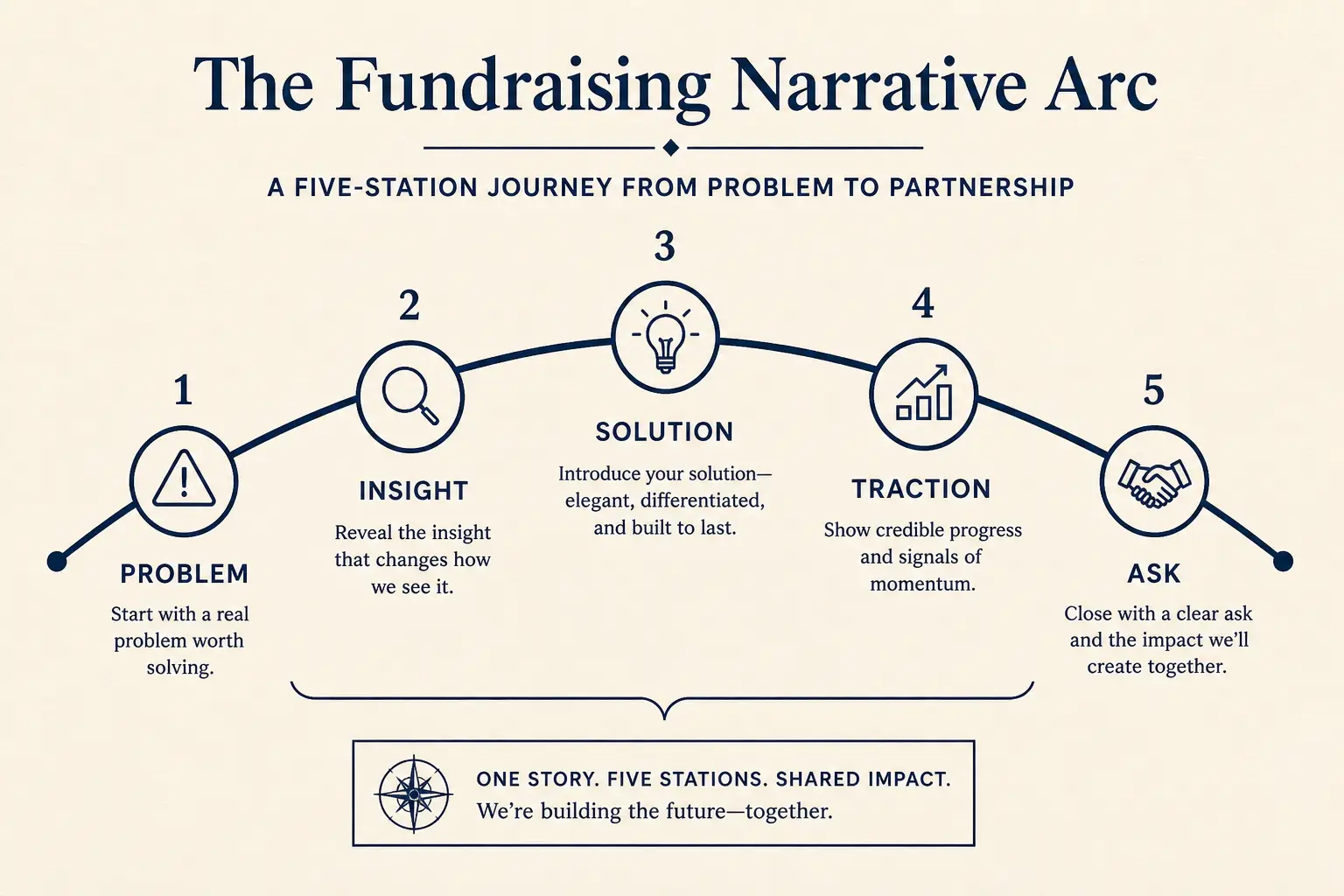
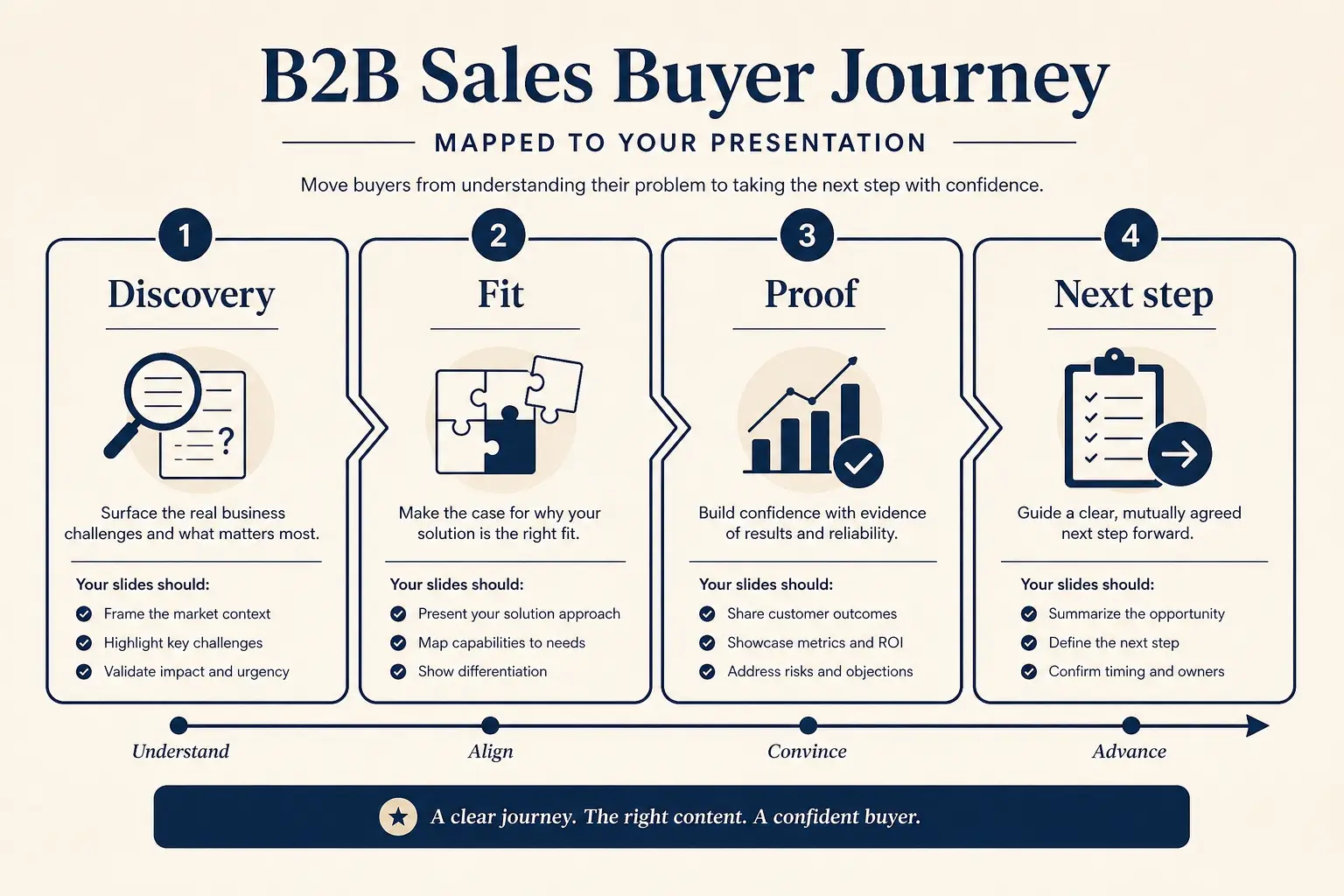
Buyer journey → slide map
Discovery
Pain + stakes
Fit
Why you win
Proof
ROI / risk
Next step
Clear ask
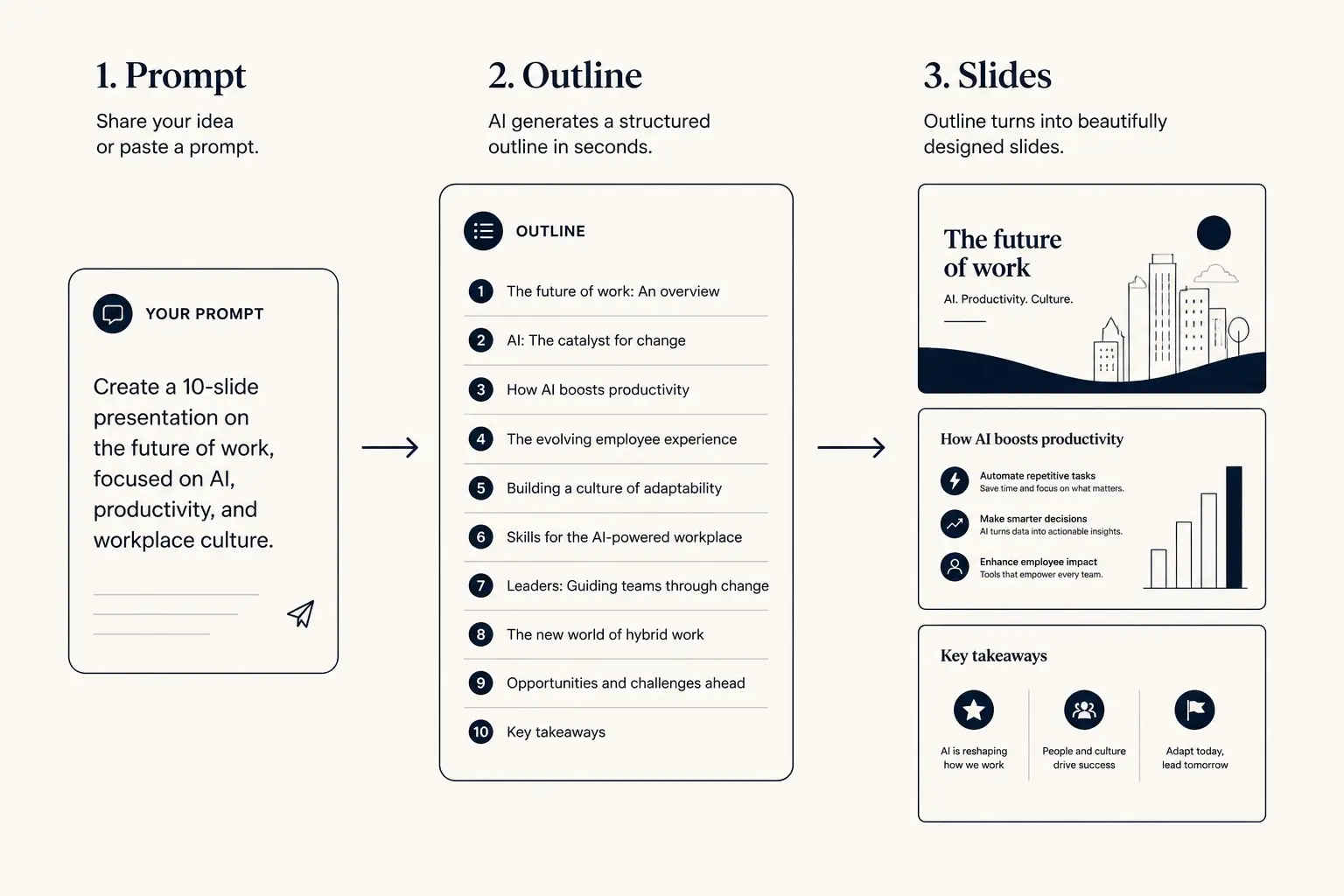
Notes to slides
Good input looks like decisions, owners, and open questions, not a raw transcript dump. Summarize first, then generate. Keep a parking lot. AI proposes structure; humans confirm decisions.
Five bullets before prompts: goal, decisions, metrics, owners, open questions. Same-day speed still needs fidelity.
Deep dive: notes-to-slides workflow spoke.
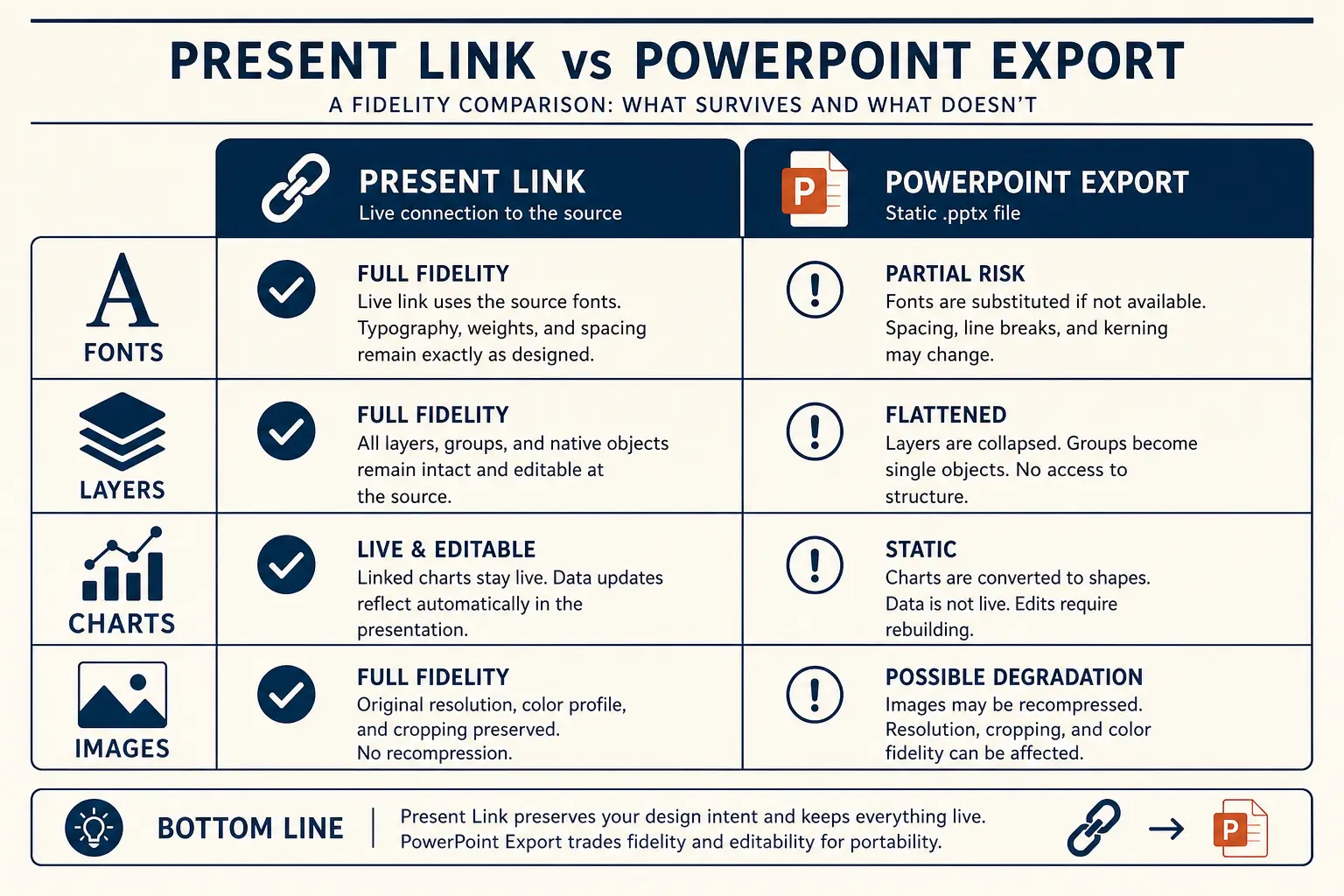
Present link vs PPTX fidelity
Present link
- • Live latest edits
- • Best for your room
- • Analytics-friendly
Export PPTX / PDF
- • Offline / procurement
- • Brand review in PPT
- • Expect cleanup passes
Docs and PDFs to decks
Long documents want distillation, not pagination. Ask for an outline of claims before slides. Preserve source citations. Expect figures to need replacement.
Extract decision sections before background. AI that paginates a PDF into twenty near-duplicates is automation without judgment.
Deep dive: PDF to presentation spoke.
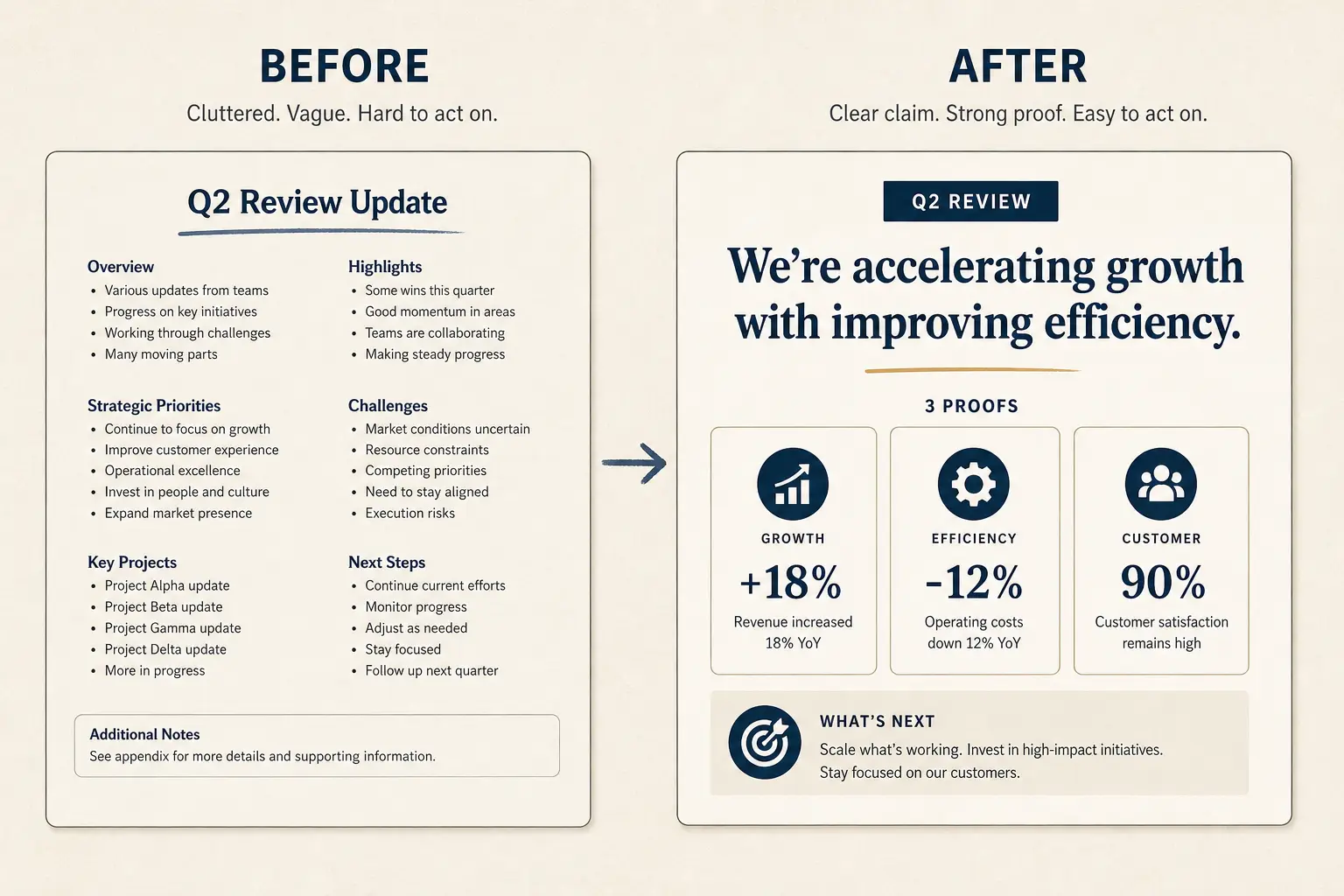
Weak slide → strong slide
Before
- • Overview
- • Features
- • Next steps???
After
- • Cost of status quo
- • Wedge in one claim
- • Proof + decision ask
Outline preview
- Narrative, open with Extract decisions, owners, metrics, and open
- Body, 3–5 slides that carry the argument
- Close, summary, risks, and the ask
Preview only, Gamma expands this into editable slides.
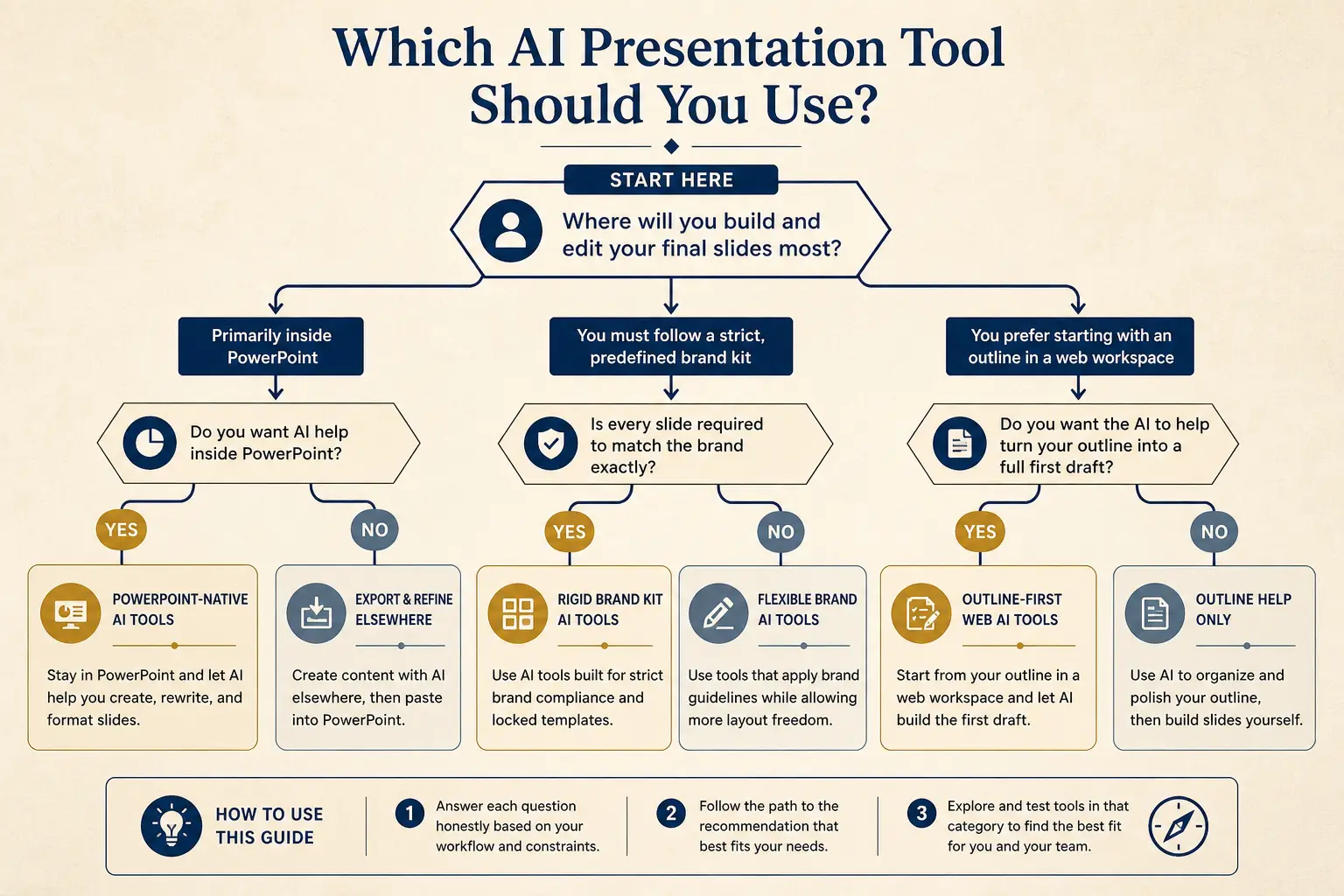
What deck are you actually making?
Three questions. One recommended path, no generic “it depends” fog.
Present link vs PPTX
Present link when you control the room and want latest edits. PDF for durable read-only packets. PPTX when PowerPoint is the system of record. Decide before fancy interactions that will not survive export.
Score tools on export fidelity only for the artifact you truly need. A great present experience with average PPTX can still be the right buy.
Deep dive: present-link vs PPTX spoke; Method for evaluation.
Slide density spectrum
Sparse
Live stage
1 claim, huge type
Balanced
Default
Claim + 3 proofs
Dense
Leave-behind
Detail for async read
Export without breaking
Design export-first when PPTX is required: simpler stacking, cleanup checklist, export-proven templates. Do not discover breaks in the client’s first open.
Budget cleanup minutes. Maintain twins when live and file jobs diverge.
Deep dive: export PPTX spoke.
Time-to-usable-deck
Blank PPT path
Outline in docs → design fight → rebuild → 3–8 hours
Outline-first AI path
Prompt → edit outline → generate → polish → minutes to first usable draft
Weak bullets → claim/proof/ask
Paste a bad slide. Get a rewrite pattern you can drop into Gamma, not vibes, a structure.
- Claim: Overview (make the cost of inaction obvious)
- Proof: Background (add a number, name, or constraint)
- Proof: Key points (add a number, name, or constraint)
- Proof: Conclusion (add a number, name, or constraint)
- Ask: Questions? (one decision, one owner, one date)
Team review rituals
Review against the decision, not against taste. Checklist beats “make it pop.” Schedule early enough that structure can still change.
Roles: narrative, fact, room. Cuts are mandatory agenda.
Deep dive: team deck review ritual spoke.
Evaluation rubric axes
Slide budget calculator
Get a realistic slide count from meeting length and stakes, then open a matching prompt in Gamma.
12
Total slides
8
Core narrative
4
Appendix
Create a 12-slide deck for executives who skim. Meeting length: 10 minutes. Stakes: medium. Use an outline-first structure with 8 core narrative slides and 4 appendix slides. Every slide needs one claim and proof.
Open this budget in GammaHand-off points that break
Workflows break at hand-offs: researcher → PM, AE → SE, founder → designer, AI draft → human editor. Define the artifact each hand-off expects.
If the next person reverse-engineers the story, the pipeline failed upstream. Version discipline matters once exports enter email.
Present links avoid stale attachments; when you must attach PPTX, name files with date and decision.
Cluster map
Start drafting in Gamma after inventories exist. Use examples for shape references.
Workflows are how AI becomes leverage instead of cleanup debt.
Operating rules for workflows
Treat Presentation workflows, from notes to present without cleanup debt as a constrained operating problem, not a theme exercise. The constraint set on this page, audience, proof rules, artifact choice, and cut list, is what makes the guidance non-generic relative to learn hub.
Write the decision or learning outcome in one sentence before you touch Gamma. Paste only proof you can defend in Q&A; blanks beat fiction. Name the artifact (present link, PDF, or PPTX) in the outline header so design stays honest. Schedule one title-only skim with a second person when stakes are external. If a section cannot map to the framework on this page, cut it rather than decorating it.
The scenario details earlier on this URL earn the long-tail ranking; these rules keep execution from drifting back to generic AI output under deadline pressure.
Edit loops that save time on workflows
Most time waste happens after generation: endless theme tweaks while titles still fail a ninety-second skim. Invert the loop for Presentation workflows, from notes to present without cleanup debt: skim titles, fix claims, fill proof blanks, then adjust visual density for the chosen artifact.
Loop A (10 minutes): title-only skim and cuts. Loop B (15 minutes): proof fill and definition footnotes. Loop C (10–40 minutes): artifact readiness, including PPTX cleanup if required. Loop D (one pass): timed rehearsal or peer read for async leave-behinds. Stop when the decision or learning outcome is unmistakable to a skeptical reader.
If Loop C dominates every week, you are designing for the wrong artifact or carrying too much decorative hierarchy. Simplify the master instead of heroically cleaning exports forever.
Vocabulary lock for workflows
Generic AI slides drift into vendor vocabulary. Lock the words your audience already uses, course rubric language, buyer phrases from discovery, investor metric definitions, or committee method terms, and paste that glossary into the prompt as a constraint.
Build a ten-term glossary for this scenario before generating. Ban three fluffy phrases that always appear in weak drafts for this job. Require metric definitions on-slide when a skeptic could misread a chart. Prefer audience-native verbs over interchangeable corporate verbs. Keep the glossary next to the prompt template so updates are mechanical.
Vocabulary locks are how long-tail pages stay specific. Without them, every deck collapses into the same interchangeable AI tone.
Ship bar for workflows
Ship only when a skeptical reviewer can answer: what is the ask or learning outcome, what proof supports it, what did we cut, and which artifact is canonical. If any answer is fuzzy, you are not done, regardless of how polished the theme looks.
Ask or outcome is on a slide, not only in speaker notes. Proof inventory matches on-slide claims one-to-one. Failure-mode cuts from this page have been applied once. Permissions or file open tests completed for the delivery path. Owners and dates exist for follow-ups when the job is operational.
This bar is stricter than “looks fine.” Clear answers under skepticism are how Presentation workflows, from notes to present without cleanup debt work actually lands.
Gamma habit for workflows
In Gamma, keep the durable habit outline-first: paste a scenario-specific prompt from this page, lock titles, generate, regenerate weak sections with diff prompts, then present or export on purpose. Do not restart from a blank vibe prompt when a long-tail spec already exists for Presentation workflows, from notes to present without cleanup debt.
Keep a team library of A-tier prompts keyed to jobs like this URL. Store proof inventories next to decks so updates are mechanical. Prefer section regen over full rerolls when one metric changes. Link learn hub from your internal wiki so people escalate to systems when they outgrow this scenario. Re-read Method when tool debates appear, architecture arguments need shared axes.
Day-to-day excellence is boring repetition of good constraints. This page supplies the constraints for one job; Gamma supplies the editable structure to execute them quickly.
Field notes 1 for workflows
When teams apply Presentation workflows, from notes to present without cleanup debt in the wild, the same friction shows up: rushed prompts, missing proof inventories, late artifact switches, and reviews that argue about taste instead of decisions. Field note 1 is a corrective habit, small enough to run weekly, strict enough to prevent cleanup debt.
Habit: freeze a proof inventory before any generate click, even when the calendar is cruel. Habit: run a ninety-second title skim with someone who was not in the working session. Habit: write the artifact choice in the outline header and refuse layout work that contradicts it. Habit: cut twenty percent after first rehearsal or first async read, on purpose. Habit: log one failure mode from this page that you actually hit, and patch the team template. Habit: prefer section regen with updated proof over full rerolls that reshuffle a working spine.
These habits are not motivational posters. They are the difference between AI that compresses work and AI that creates a second shift of cleanup. Attach them to learn hub rituals so they survive personnel changes.
Field notes 2 for workflows
When teams apply Presentation workflows, from notes to present without cleanup debt in the wild, the same friction shows up: rushed prompts, missing proof inventories, late artifact switches, and reviews that argue about taste instead of decisions. Field note 2 is a corrective habit, small enough to run weekly, strict enough to prevent cleanup debt.
Habit: freeze a proof inventory before any generate click, even when the calendar is cruel. Habit: run a ninety-second title skim with someone who was not in the working session. Habit: write the artifact choice in the outline header and refuse layout work that contradicts it. Habit: cut twenty percent after first rehearsal or first async read, on purpose. Habit: log one failure mode from this page that you actually hit, and patch the team template. Habit: prefer section regen with updated proof over full rerolls that reshuffle a working spine.
These habits are not motivational posters. They are the difference between AI that compresses work and AI that creates a second shift of cleanup. Attach them to learn hub rituals so they survive personnel changes.
Frequently asked questions
Run your next deck through a real pipeline
From notes to outline to present, test the workflow in Gamma before the deadline.